
Wealthy Mindset vs Poor Mindset (Part 1)
Episode 004: Wealthy Mindset vs. Poor Mindset (Part 1)
Synopsis In this episode, Jared launches a three-part deep dive into the most foundational component of the "Everything Is Investing" philosophy: the Wealthy Mindset versus the Poor Mindset. Moving beyond the "vibes-based" fluff of manifestation and motivational "ear candy," Jared explains why mindset is the primary determinant of your investing trajectory. This episode establishes the ground rules for the series and unpacks the first three of sixteen mindset parallels: Time Horizon, Scarcity vs. Abundance, and Ownership. Through practical examples—ranging from propane math in a camper van to grade-school soccer rivalries—you will learn why returns are impossible without a long-term view, a positive-sum outlook, and the willingness to own your outcomes.
Sequential Outline
I. Introduction to the Mindset Series
- (0:10) Foundational Concepts: This is a collection of parallels that tie together everything Vested focuses on.
- (1:17) Solving the "Mindset Problem" in Podcasting: Jared acknowledges that mindset content often has a bad reputation for being surface-level or "vibes-based."
- (3:02) From Motivation to Transformation: EII mindset is not about "believing in the universe"; it is about finance applied to behavior. It requires frameworks, feedback loops, and identifying input/output relationships.
- (5:44) Putting in the Reps: Magical thinking doesn't build wealth. It doesn't matter how well you "manifest" if you don't actually put money or effort to work.
II. Prerequisite for Returns
- (6:53) Predictor of Outcomes: If you show Jared a person’s true mindset, he can predict their future returns. Mindset is the biggest determinant of investing behavior—whether you make the deposit or withdrawal in the first place.
- (8:15) Knowledge vs. Mindset: You can have the tools of portfolio management memorized, but if you have a poor mindset, you will fail. Conversely, someone with a wealthy mindset but little knowledge will eventually find success because of their trajectory.
III. The Six Mindset Disclaimers
- (9:13) Overlap: The 16 parallels are not perfectly distinct; they are interrelated.
- (9:45) The Spectrum: Mindset is not a binary; we move back and forth on a spectrum in different areas of life.
- (10:20) Not Determinative: Exceptions exist—rich people with poor mindsets and broke people with wealthy ones.
- (11:00) Beyond Money: A "rich life" is defined by purpose, impact, and peace, not just the size of an account.
- (12:56) Trajectory over Position: Your mindset says more about where you are going than where you are standing.
- (13:46) Awareness for Improvement: This list is for self-audit, not shame or superiority.
IV. Parallel #1: Time Horizon (Short-term vs. Long-term)
- (15:33) The Poor Side: A short-term focus where time is viewed cheaply and "spent" on the immediate.
- (16:00) The Wealthy Side: A long-term focus where time is the most precious resource to be invested for decades.
- (18:23) The Propane Bottle Story: Jared recounts trying to help a man living in a camper van.
- The man was begging for $8 to buy a one-pound propane bottle to stay warm for one night.
- The Math: Jared offered a $50 tank and a cheap adapter that would provide propane for less than $1/lb (a $7/day savings).
- The Mindset Trap: The man rejected the solution because he was locked into a 24-hour focus. A short-term mindset makes proper resource allocation mathematically impossible.
- (22:11) Prerequisite for Failure: A short-term focus is almost always a prerequisite for bad outcomes in life.
V. Parallel #2: Scarcity vs. Abundance (Zero-sum vs. Positive-sum)
- (25:38) The Poor Side (Scarcity): Life is a fixed pie. Someone else winning means you are losing. This leads to jealousy and cynicism.
- (25:57) The Wealthy Side (Abundance): Life is a positive-sum game. More people winning makes the pie bigger for everyone.
- (28:50) The Soccer Story: A grade-school player tells Jared, "I don't care if we win, I just want a better record than the other team." This is the definition of mediocre mindset—being okay with doing poorly as long as others are worse.
- (30:17) The Survey: People were asked if they'd rather make $80k in a neighborhood where others make $40k, or $150k where others make $300k. Fully half chose the lower amount just to be "comparatively" better.
- (35:34) The Steve Jobs Example: Society realized thousands of times more benefit from the iPhone than Jobs did personally. Abundance mindset celebrates this because it understands that proxy-benefits make the world better for the individual.
VI. Parallel #3: Ownership (Abdicated vs. Owned)
- (39:12) The Poor Side: Rejects ownership and responsibility. Blames others, avoids problems, and refuses to admit mistakes.
- (39:44) The Wealthy Side: Embraces ownership of things and responsibility for outcomes.
- (40:51) Renter vs. Owner Mentality: "No one has ever taken a rental car through the car wash." Owners care for things because they have "skin in the game."
- (42:53) Life Responsibility: If nothing is ever your fault, you have no power to change your trajectory.
- (44:28) Mental Ownership: You don't need a legal title to act as an owner in your church, school, or business. Acting as an owner creates the returns you seek.
- (46:06) The Direction of Care: We don't just invest in what we care about; we care about what we invest in. If you wait to "care" before you invest, you may never start. Investing creates the value.
- (48:44) The Prerequisite for Returns: You cannot get returns on something you do not own. Ownership is the single biggest prerequisite for positive compounding.
VII. Summary and Closing
- (50:12) The "Empty" Equation: Short time horizon + Scarcity + No Ownership = Negative or zero returns.
- (50:25) The "Wealth" Equation: Long time horizon + Abundance + Full Ownership = Limitless upside.
Quotes to Remember
"Our mindset is the biggest determinant of our investing behavior. Whether we make the deposit or the withdrawal in the first place is determined by the lens we are looking through."
"Time Horizon is probably the single biggest determining factor between poor outcomes and wealthy outcomes."
"A short-term focus is not just a predictor of bad outcomes; it is a prerequisite for them."
"We don’t just invest in what we care about; we care about what we invest in. If you wait to invest in something until you care enough, you may never make that investment."
"Responding to other people's success with 'Heck Yeah' shifts your perspective toward abundance, even if you don't believe it right away."
"You don't get returns from other people owning things. You get returns from you owning them."
Next Episode: Wealthy vs. Poor Mindset (Part 2): Diving into Purpose, Strategy, and the difference between Investing and Gambling.
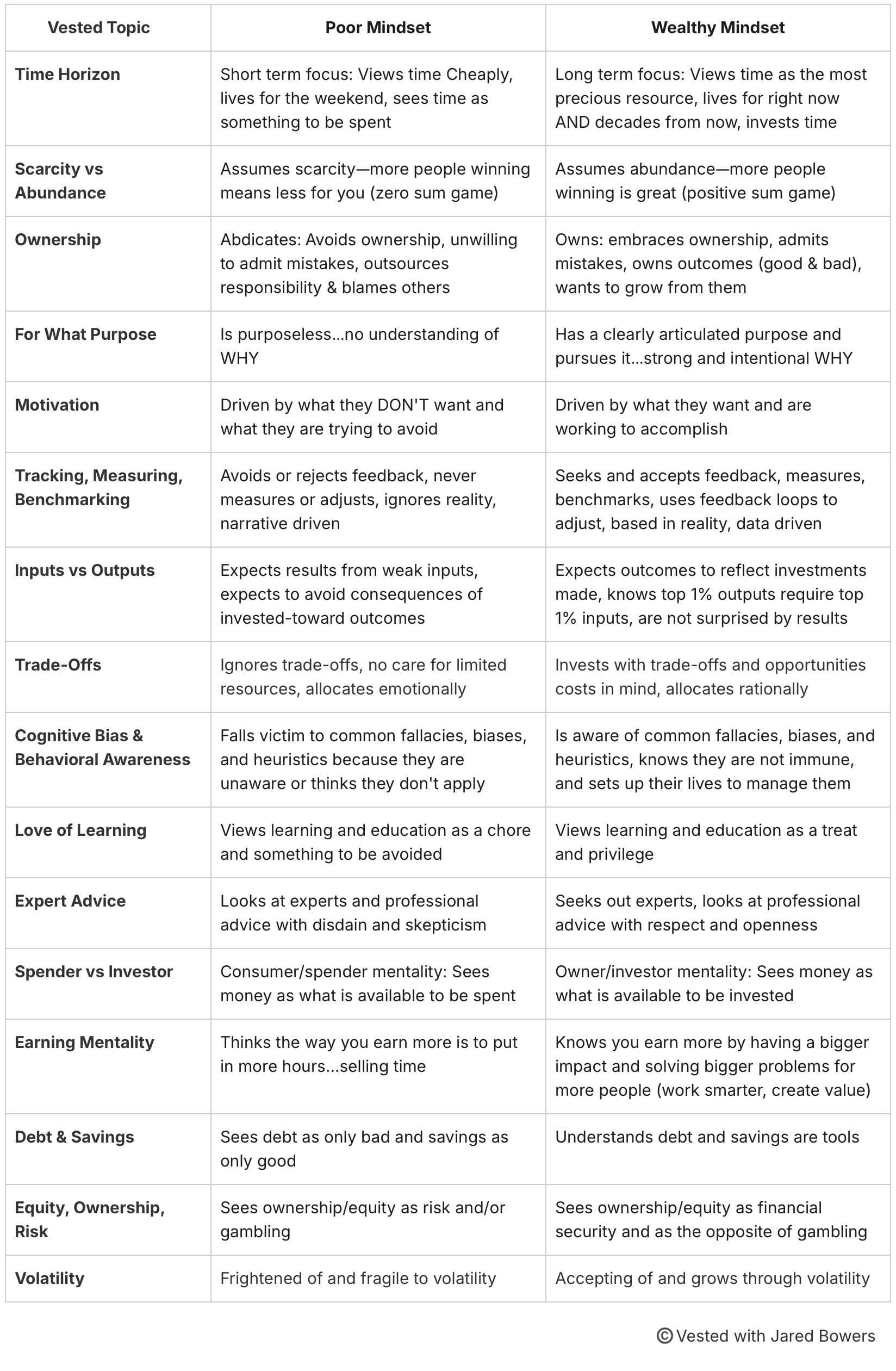
The Poor vs Wealthy Ledger
004 - Poor vs Wealthy Mindset Part 1 Full Transcript
Introduction to the Mindset Series
(0:02) Good day, investors. Welcome. I'm Jared Bowers. Today, and in the next two episodes, we get to dive into one of the most foundational concepts and applications of this philosophy of everything is investing. More accurately, what we're going to dive into is a collection of parallels that ties together almost all of what we will focus on and what we are going to talk about from here. And we're going to do that across multiple episodes.
(1:00) Three episodes, in fact. A deep dive already, huh? Yes. Very exciting. Because I've been teasing deeper dives, haven't I? That time has finally come. And what we are going to be diving into is the wealthy mindset versus the poor mindset. And before we dive into other investment-related content from here in future episodes, tools of portfolio management, investing practices as applied to both money and to life, to make sure that we're all working from the same page and the same basis of understanding, this focus on poor versus wealthy mindset is going to be an important thing to cover.
Solving the "Mindset Content" Problem
(1:46) And some, when you hear mindset, are going to be excited, because you love talking about mindset. And others of you may roll your eyes a little bit, because podcasting in general has a reputation of talking about mindset and focusing on mindset a lot, especially the self-help genre of podcasting, which I'm not sure if that's exactly where we're going to fall into, probably, to be fair. Of course, finance and investing is the overarching topic. We have and will talk plenty about money. But mindset content in podcasting has a bad reputation. And there is a very clear reason why.
(2:36) And I don't think that it's about the focus on mindset. I think that it's about how many people talk about and apply mindset. And what we are going to do when we talk about mindset is try to solve for some of those deficiencies that give that mindset-focused content a bad name. One reason why the mindset focus in podcasting has a bad reputation is because it just throws around words like habit, discipline, manifestation, gratitude, abundance. I'm guilty of that myself when it comes to some of those words. And often, those terms are thrown around without tying them to real-world systems or showing how they translate into real-world outcomes.
(3:35) It mostly is very vibes-based, very surface-level, simply motivational instead of what should also be applicable for the purpose of being transformational. When we talk about mindset, we are going to apply it to specific investment and behavioral frameworks and practices. We need to have a framework, then we need to apply it, which will determine the direction of our compounding and the magnitude and direction of the returns that we get. And that's not vibes or manifestation. That's finance. And I love finance. But again, finance that is applied to both money and to the important things beyond money.
Motivational vs. Applicable Frameworks
(4:29) Another issue with the mindset focus in the self-improvement side of podcasting is it often is just feel-good entertainment rather than real application and instruction with substance. It is very motivational. It's inspiring. It elicits an emotional response, which can feel great and can be fun to listen to. But it kind of evaporates at the end of the episode because there's not really any meat or application. We need to be able to identify feedback loops so that we can adjust our behavior. Examples of input and output relationships that we can use. Examination and accounting of opportunity cost. Measuring, tracking, and benchmarking to determine if we are heading in the direction we want to be heading.
(5:20) And what I think people really want from mindset-focused content is information and instruction that they can actually apply, not just ear candy. I think they're looking for models, equations, frameworks, examples of cause and effect, application in the real world. But oftentimes, personal anecdote is all that those podcasts rise to. We encounter this in all sorts of digital media. "My life was a mess, then I learned XYZ mindset, and now everything is amazing. You just need to manifest it. You just need to believe in it enough." And we know and recognize that for what it is. Mostly just feel-good fluff.
(6:17) And so, we are not going to over-index on manifestation. Thinking about something, believing in it, thinking the right thoughts, focusing in the right direction of the universe, hoping that it will send you what you want or what you need. That empty approach immediately loses credibility from my standpoint, and probably from yours as well. People know that that is not how the world works. We actually need to do the work. We actually need to put in the reps. We need to make the deposits that are needed to build the balances we want. And it is not about magical thinking.
Mindset as a Predictor of Returns
(7:04) From an investment standpoint—and let's talk about money investing—it doesn't matter how great your mindset is and how well you may manifest wealth going forward. If you don't actually take action, solve problems, identify opportunities, and put money to work. Without those things, you're not going to get the returns because no investment was actually made. The examples that we will discuss will be connected to reality, to real-world stakes. What we want is to have real-world application that is grounded, actionable, measurable, relatable, and inspiring. And maybe it will even give some of those warm, fuzzy feelings that the mindset-focused self-help fluff can give you.
(7:53) And I think that's okay in appropriate doses, but there has to be a balance between the meat and potatoes and the dessert. And as we talk about wealthy versus poor mindset over the coming episodes, I want to make clear something else. Mindset is not everything, as we know, but it is a lot of it in investing. Both financial investing and life investing. You get what you pay for. You get the returns that you invest toward. You grow the accounts that you make deposits into. And the precursor to most of what determines how we invest and what we invest in is the mindset that we operate from.
Behavior Over Knowledge
(8:48) If you show me a true picture, a real representation of someone's mindset when it comes to any area of their life, I can likely predict their future returns in that area. And it's not a special skill that I have, so can you. Because our mindset is the biggest determinant of our investing behavior. Whether we make the deposit or withdraw in the first place, that is what makes this foundational, so important. That is why it overarches and interweaves everything that we are going to talk about from here. And these next few episodes may lean more philosophical than practical, more general than specific, but it does represent an important piece of the investing pie.
(9:43) Anyway, another point that ties into behavior: Knowledge can only get us so far. Someone can have all the steps and tools and recipes of exceptional portfolio management memorized, and it will avail them not much if they approach life and live life with a poor mindset. And, as often is true with what we talk about, someone can know very little about the tools and recipes and investing strategies. But, if someone approaches life with a wealthy mindset, they will very likely find success in most of the areas that they apply that wealthy mindset to. Mindset is crucial because it impacts our behavior much more strongly than knowledge or even opportunity does.
The Six Disclaimers
(10:32) Okay, before we dive into the 16 parallels of wealthy versus poor mindset—and don't worry, again, this will be covered in multiple episodes—I have some disclaimers to point out. First disclaimer: Each of these 16 parallels is not perfectly distinct. There is some overlap between them. If an editor, my editor, my wife, got a hold of this list of 16, she might really want to consolidate a few of them, because some of them are related. But I believe that there is enough distinction that each merits its own parallel. Because they each have unique and applicable characteristics important to investing across life.
(11:24) Second disclaimer: These mindsets, like most things, exist on a spectrum. And we can move on that spectrum, and we do move on that spectrum between wealthy and poor in different areas of life over time. Maybe even between good weeks and bad weeks that we're having. We typically don't firmly plant ourselves on one side or the other of wealthy versus poor mindset and then never change. There are some that are on the far side, the middle, or the far opposite side on these spectrums. But we can and do move. And that should be encouraging. Third disclaimer: These mindsets between poor and wealthy are not completely determinative by themselves.
(12:17) There are wealthy people who embody at least some of the poor mindset traits. And there are poor people—not just talking about money, but in the areas of life that they care about—who embody some of the wealthy traits. But it is rare that someone who mostly falls on the poor side of the ledger lives what could be considered a wealthy life. Similarly, it is rare that someone who falls mostly on the wealthy side of the spectrum lives what would be considered a poor life. Next disclaimer, number four: This goes beyond money. I think I've mentioned that.
(13:08) Like most things, the application goes beyond money. Just by nature of how I've named it and described it, wealthy versus poor, it's going to sound like I'm talking primarily about money at times. And many of the points and examples do involve and will involve money. But this is a very important point: The wealthy versus poor mindset is about our approach to, and therefore outcomes in, life, not just with money. And this is important because I know people who are living very rich lives who would not be considered rich in monetary terms, at least by American standards.
(13:54) Probably most of the Americans that I know would still be considered pretty darn rich by world standards. But this does also apply to the people I've known and worked with and lived around in much poorer countries as well. It goes beyond money. Because those rich lives are defined by the purpose they're living for, the impact that they're having, the peace that they have, the family that they've built, much more so than how much money they have in their investment account, or what house they live in, or what cars they drive, or what their net worth is.
(14:47) Many people who are living very rich lives live with that wealthy mindset approach, and are purposefully working jobs in fields that don't come with big paychecks. That doesn't mean that they're poor. Purpose and investing well in the things that you care about are much more important than the size of your investment account. Now in the future, I would like to talk about how people in those fields that may not come with big paychecks can still live well monetarily. That, I do not believe, is taken off the table in most cases. But we're going to set that aside for now because I have another disclaimer.
Trajectory vs. Current Position
(15:31) And that is, when it comes to money, there are wealthy people that live and operate with a poor mindset. And conversely, there are broke people that operate with a wealthy mindset. Because your mindset says much more about your trajectory and your likely future outcomes than it does about your current financial position or your current position in anything that you are investing in. Again, hard and fast, determinative relationships, perfectly positive correlations in the real world usually don't exist. That goes back to my comment about the spectrum. You are going to come up with examples of exceptions. Many of you will be the example of the outlier, of the exception.
(16:23) Now the final disclaimer. I think that's number six. What we are going to be talking about going forward is about awareness for the sake of improvement. Not to cause feelings of shame or guilt or establish superiority or inferiority. Because I struggle with some of these same items on the poor side of the ledger myself. And I will point out some of those. And I think that we will be served well by paying attention to this list and then applying this list of wealthy versus poor mindset traits. Because these are prerequisites to the path that you want to be on and that you will be on.
The First Three Parallels
(17:23) Yes, this goes beyond money and it is strongly related to money as well. And the people that I work with, that I help, that I teach, they clearly want better money outcomes. But they also want better outcomes in life. Okay, with all that being said, and obviously we're going to need multiple episodes on this if just the preamble and the disclaimers took this long, in the remaining time that we have together in this first episode, part one on wealthy versus poor mindset, I want to cover the first three on the list in detail. Because of how important and foundational they are. And I'll give them to you up front: they are Time Horizon, Abundance, and Ownership.
Parallel #1: Time Horizon
(18:20) Aha! There is one of those manifestation words already. Abundance. Did I lose credibility already? Hang with me for a bit and then decide. Because these three, time horizon, abundance, and ownership are foundational to investing across life. Financial, relationships, health, all of the above. And let's dive into each one in detail. Okay, number one, time horizon. When it comes to time horizon, the poor mindset side is—you can probably see this coming—a short-term focus. Those with a poor mindset view time cheaply. They live for the weekend and see time as something to be spent. Very little focus on anything that goes beyond the immediate.
(19:17) The wealthy mindset, in contrast—and you likely already have this in mind as well—is, of course, a long-term focus. Those people view time as the most precious resource. And yes, they do live for right now, that's where we live, but they also live for years and hopefully even decades from now. Ideally, decades from now. Instead of just spending time, they invest it with intention, on purpose. Let's dig deeper into the poor side first. Those of us who have lived some life have probably had periods of time where this is relatable. But enough about us, it is way more fun to apply this to other people, in terms of the poor mindset side of the ledger, of course.
Story: The Camper Van and the $8 Propane Tank
(20:14) Consider someone in your life that is getting really poor investment outcomes, just not advancing in any capacity or area, probably going backwards. The reason that time horizon is on the top of the list is that I would bet a lot of money that that person that comes to mind who is getting terrible investment returns almost certainly has a short-term focus in what they do in life. A short-term focus does not just have a strong influence on investment returns in the wrong direction; I believe it is often a prerequisite to getting bad outcomes in life and investing. It is a determinator of bad outcomes.
(21:08) Having that short-term focus, no view for longer than right now, or maybe just a few days from now. That person is probably getting poor outcomes across multiple areas because if someone has a short-term mindset, they tend to apply it across the board. A more extreme example that comes to mind for me related to this is from a few years ago when I tried to help a guy who was living in an old camper van. He stopped by my church in the middle of the week when I was leaving a meeting, and he approached me in the parking lot asking for gas money. It was the middle of winter, and where I'm from that means snow and really cold.
(21:58) This gentleman was clearly on the edge of being homeless, but he had his old camper van. We do try to help as many people as we can at our church, and instead of pointing him to our pastor, I told him that I won't give him gas money—many of you know why—but I'm happy to follow him to the gas station and fill up his van. So we did that. And while we were filling up his van, he asked me for $8 so that he wouldn't freeze tonight. That's the way he phrased it. And of course I wanted to dig into what he meant, because $8 to keep someone from freezing? Tell me more!
(22:54) And he told me that he has a small propane heater in his van, and a one-pound propane tank runs the heater on low for long enough during the night so that he stays warm enough. And a one-pound, single-use, non-refillable propane bottle costs about $8. And when I realized that this was what he was talking about, my math brain and problem-solving side started to kick in. I did my best to get across to him that with a pretty cheap adapter for his heater and a $50 propane tank that holds 20 pounds of propane that can be refilled for less than $20, he would have propane for less than a dollar a pound.
(23:44) That is $7 a day of potential savings. That $7 a day for someone in that position is the difference between going to bed hungry and cold versus going to bed warm and fed. I even offered to go to the hardware store nearby and buy him that adapter, but he would not even consider it because a $20 propane tank costs a lot more today than a one-pound can does. And he knew from experience that he could beg $8 from people. He might not be able to get $20 when he needed a refill. And you and I hear that, and we can very quickly do the math.
(24:43) That $8 per night in the winter is about $240 a month, which is probably more than what most of us pay to heat our entire homes for a month in the winter. And if we had the opportunity to make a small investment to heat our homes for one-eighth the cost, $30 a month instead of $240, we would rearrange our schedules to do it immediately. But the thought that this gentleman could think about investing well in anything with a focus that is 100% tuned to 24 hours or less is out of the question. There was no thought for outcomes beyond the next 24 hours, and therefore, there was no chance at proper resource allocation and long-term good decision-making.
Long-Term Focus as a Prerequisite
(25:31) I'm sure this gentleman was dealing with all sorts of different struggles. His time horizon is not the only thing. But there is one common factor underlying this example and the examples of poor returns in life and investing poorly that we can all identify. In other people, of course. These outcomes are always preceded by and often caused by a short-term focus. This is true in my experience and very likely true in yours as well. When we cannot look beyond what is right in front of us, we are locking ourselves into a short-term focus with almost guaranteed poor returns. Contrast that with the wealthy mindset: the long-term focus.
(26:21) Those who view time as the most precious resource. Yes, they do live for right now. That's where we live. But they also live for years and hopefully even decades from now. Ideally, decades from now. Instead of spending time, they invest time as their most precious resource. Now let's do that same exercise in reverse. Think about someone you know who is getting the best investment returns across multiple areas of life. They are killing it. And since we had to think about someone else in the first example, I'm asking you to think about someone else in this example as well. You are still off the table.
(27:11) And these returns don't have to just be financial. They can be from an impact standpoint, relationships, health, what they are accomplishing, the impact that they're having in their community and on those around them. And I will bet you, again, if I was a betting man, I would nearly guarantee that they have a long-term focus. Because that is, again, a prerequisite. It underlies and interweaves those good long-term returns. The person who is clearly investing well, regardless of what area of life we're talking about, very likely has a long-term focus. And if you've noticed those returns, you can probably even see from the outside evidence of that long-term focus.
(28:13) Investments that they laid years ago, maybe decades ago that are maturing, paying dividends, and still growing right now. This is why Time Horizon is so important, so foundational. It is very hard to get good investment returns with a short-term focus. It takes them off the table in most cases. And it's almost hard not to get good returns if you invest with some level of consistency with a long-term focus in mind. That is why Time Horizon is at the top of the list. And we can and do exist on a spectrum. Some are excellent at managing money with a long-term focus, but are very bad at managing health with a long-term focus.
(29:07) Some are great at focusing on long-term relationship health, but then we have a very short-term, poor mindset when it comes to our spiritual health. And if all we do is align the areas that we care about more in line with a long-term focus of that wealthy mindset, and change nothing else, we are probably going to start getting better outcomes. Time Horizon is crucial, and probably the single biggest determining factor between poor outcomes and wealthy outcomes. Now let's talk about the second item on our list: Scarcity versus Abundance.
Parallel #2: Scarcity vs. Abundance
(30:00) The poor mindset assumes scarcity, of course. More people winning means less for you. They approach life as a zero-sum game. Resources are mostly fixed and limited, and I need to get what is mine. The wealthy mindset, in contrast, assumes abundance. More people winning is great. It is great for them and it is great for you. They approach life as a positive-sum game. More accurately, a positive-sum investment. Now let's dig into the scarcity mindset, the poor side of the ledger. Someone winning means you are losing. More for someone else means less for you. A zero-sum or negative-sum approach to both life and investing.
(30:52) With that scarcity mindset, good things aren't good things unless they're your good things. Other people's wins feel threatening, or feel like a loss. If my neighbor gets a new car or gets a promotion, I feel worse by contrast because I didn't get that. Jealousy and cynicism abound on this side of the ledger. People with a scarcity mindset view the pie as fixed. Someone getting a piece means that piece isn't available for me. And this is an incredibly limiting and detrimental way to approach life. Very few of us are going to see ourselves in it when I describe it like that, but this is a common mindset that we can and do fall into.
Story: Grade School Soccer and the "Sister Team"
(31:41) We have to be able to identify it and do what we can to move away from it. Now a somewhat recent example of this comes to mind. I volunteer to coach 4th through 6th grade soccer for the school that my kids attend. One of my favorite things about coaching is the human interactions and the very human responses from these little people. Coaches can say things matter-of-factly and give very direct feedback that doesn't require patting them on the head. "Hey, you can do that better. Go do that again." Or, "don't ever do that again." And thankfully, often, "good job, that's how it's done."
(32:36) We had two teams one year at our grade school soccer level because we had such strong numbers. A good problem to have, but that also meant that our team's strength was effectively cut in half. Great opportunity for development—didn't win many games. And at the tournament at the end of the season, my team had not done very well after the first two games—a loss and a tie. That was not a position that we were used to being in considering that our single team had dominated the past couple years and won the tournament. And ahead of our third and final game, one of my young players said in front of the entire team:
(33:34) "I don't care if we win this final game. I just want to have a better record than the other team." Meaning our other team. And our other team had two losses at that point. So if we lost this next game, he was just really hoping that our sister team also lost their game as well. So that our result of loss-tie-loss would be better than their result of three losses. And I did what a coach should do in that situation. I told this player to not say stupid things, especially in front of the whole team. Then I pep-talked my team as best I could ahead of that final game that we did in fact lose.
The Purchasing Power Survey
(34:05) But I share this as an example to point out a mindset that many of us have, not just as kids. "Okay, I'm doing poorly. I'm okay being mediocre as long as other people are doing the same or worse." And that is just a flat-out wrong and terrible way of approaching life. There's a survey that I've heard discussed many times, but I've never read, which means that I can talk about it like I'm an expert in the subject, right? Essentially, my understanding of the survey is that it was done to determine what people would rather have when presented with two different options.
(34:51) The first is where everyone around you in your neighborhood makes a comparatively small amount of money, let's say $40,000 per year, but you make $80,000. A meaningful amount more. Or a situation where everyone around you makes a comparatively large amount of money, let's say $300,000 per year, and you make $150,000. Comparatively much less. Now on a raw dollar basis, that's pretty easy math. This survey assumed equal purchasing power, but fully half of those surveyed chose Option A. They would rather have half the purchasing power as long as they were making double what those around them were making.
(35:34) And that has been identified in other areas. People would rather be less physically attractive overall as long as they are comparatively more attractive than those they interact with. Meaning, they would rather live in an "uglier" world as long as they were comparatively better. That, my friends, is the scarcity mindset in action. And it is all around us. And that mindset, when practiced by enough people, results in a poorer and uglier world. And, for the practitioner of that mindset, it does result in a poorer and uglier world for them. Individually, worse outcomes.
The Abundance Mentality
(36:40) But we don't have to be convinced of the fact that the scarcity mentality is bad. We can identify it when we hear it described. But we are drawn to it in so many different areas of life. It creeps in. Oftentimes, it can be dictated by whether we like another person or not. We tend to have a much easier time celebrating the success of someone that we like. But when someone experiencing success is a person that we're not connected to, or especially when it's someone that we don't really like, we see that oftentimes as a bad thing. But that clearly is jealousy, and that is scarcity.
(37:39) And it's a very common mindset that we might not even know that we have unless we are looking for it and we identify it when it happens. Applying that mindset to areas of our lives is limiting because if we approach life from the standpoint of limited resources, fixed pie, then we are going to be much less likely to invest. We are going to be much less likely to realize the benefits of other people's success by proxy. If life is a zero-sum game, we have to hoard resources. We should only spend on ourselves, not invest in others. So then we will be less likely and miss opportunities to be invested in by others.
Positive-Sum Investing: The iPhone Example
(38:31) People with a scarcity mindset approach life like it's a class with a teacher that's giving out a fixed number of A's. Your classmate getting an A means that you're less likely to get an A. But we can see that as ridiculous. That is not how life works. Now, let's talk about the wealthy side: the abundance mentality. The mindset where more people winning means more value is being created. More for them, more for you, more for everyone. People with the abundance mindset believe that when more people win, the pie actually gets bigger. And the opportunity for more pieces or bigger pieces grows.
(39:39) You winning and doing better means that the world gets better for not just you but for those around you. The wealthy mindset of abundance is a positive sum approach to life. More value created makes the pie bigger. Other people's wins become a catalyst for your wins, just like your wins benefit those who are close to you. You should be living a life where if you succeed, the people around you are better off. Because abundance is how the world works, when it is working correctly, often those around us are better off simply by proxy. They didn't even have to do anything.
(40:23) This incredible modern world that we live in is the biggest example of that. We are the beneficiaries of those who came before us and made the pie bigger. Consider inventors or business leaders who succeed greatly. Probably the most successful inventor and business leader of the past century was Steve Jobs. He became a multi-billionaire and planted the seeds of what would become a multi-trillion dollar company today, Apple, by inventing multiple breakthrough products. Yes, that made him rich. Yes, that made his company very large. But it also had a massive impact on the world.
(41:04) Just consider the iPhone, one of the products that he invented, or at least perfected at the time. Think about the benefit that you and I have personally gleaned from just the invention of that smartphone device. And now add that up over hundreds of millions of people who have owned those devices. The benefit we have received collectively vastly outweighs any benefit he ever got from it personally. No single person got wealthier on the iPhone than Steve Jobs did, but society was impacted to a magnitude hard to calculate—probably in the hundreds or thousands of times greater than his specific monetary benefit.
Shifting the Mindset: The "Heck Yeah" Approach
(41:56) Society realized more, probably thousands of times more, maybe even millions of times more. And if you approach life and investing with that abundance mentality, you are more likely to invest. You are more likely to be in situations and live life with other people who are looking to invest in themselves and in you. This abundance mindset sometimes doesn't come naturally. It needs to be practiced. If you look at kids, there's a whole lot of scarcity going on. "Mine! Not fair! He got more than me!" That kid, I believe, is still inside of us.
(42:45) One of the most powerful things that we can do to practice abundance and chase away scarcity is the "Heck Yeah" approach. When you see someone succeed, get something that you don't have, or have a good outcome, make yourself say, "Heck yeah. Good for them." Even when you don't want to—probably especially when you don't want to. Respond to other people's success the same way you would want them to respond to yours. And you will get better at it over time, even if you don't believe it right away. It will start to shift your perspective and shift your mindset toward abundance.
(43:17) And it will result in better outcomes for you over time. So yeah, ultimately, I guess it's about being selfish, but truly, we shouldn't just be doing it for ourselves. Shifting toward an abundance mindset opens up the opportunity to invest better in yourself and in others. Seeing the pie as fixed results in a protectionist approach to life and a viewpoint of shrinking investment accounts. Seeing the pie as growable results in seeing more of the opportunities around you, and then having the willingness to invest in them.
Parallel #3: Ownership
(43:41) Alright, and finally, for today, let's cover Ownership. Number three on the wealthy versus poor ledger. On the poor side of the equation, ownership is abdicated, given up, rejected, or avoided. The poor mindset doesn't invest because they reject ownership, not just of things, but of responsibility. Those with a poor mindset avoid addressing problems and they're unwilling to admit mistakes. They outsource responsibility and they blame others. On the wealthy side, ownership is owned. It is embraced. "Owned" is the operative word here, isn't it?
(44:19) They put their money to work in things that appreciate in value. They invest their limited resources of time, energy, and money in the areas that they have ownership in, and that they want to build and grow. And it's not just with things, it's with responsibility. They address known problems. They bring solutions and are willing to help. They admit mistakes and they own outcomes, both good and bad. And they want to grow from them. As we dig into the poor side of the ledger, it should not be hard to see how this mindset is limiting.
(45:07) Because if ownership is rejected, if you don't own anything that can compound and grow, you don't have anything that can produce returns. In order to invest, you have to have ownership in something. Removing ownership removes any possibility for future returns and for future growth. Ownership matters. Something you'll hear me reference in the future is the Renter versus Owner Mentality. I think this fits well here. There are places where you can drive through a neighborhood and probably guess which houses are being rented versus owned based on how things are cared for.
The Renter vs. Owner Mentality
(45:43) Yard work, landscaping, blinds, patio furniture. And I don't believe this is just because an owner might have more money, but it's because an owner has ownership. Renters are less likely to address issues, beautify the house, or make connections with neighbors. We've all heard the phrase: "no one's ever taken a rental car through the car wash." I'm sure someone has, but yeah, it's unlikely. And don't hear me say that renters are worse people than owners. I have been a renter in the past, and my neighbors were just less interested in connection compared to where I've owned my home.
(46:10) This is built into human nature. If you know that your job is short term and you may move in the next couple months, you're probably going to be renting and you're probably not going to be putting down roots. That doesn't make somebody a bad person, it just is a reflection on being a renter versus being an owner. Ownership is not just a legal state of possession and rights. It is a powerful driver of our mindset and our behavior. And because of that, it is a powerful driver of our returns. This applies to all areas of life.
(47:00) If someone does not take ownership of the investments that they are making and the returns that are being produced, there is very little hope for strong returns. We can all think about people who reject ownership in life—not just from a money standpoint, but from a life investing standpoint. Nothing is ever their fault. Everything is always someone else's fault. These people may want to take credit for wins when they happen, but nobody believes them because they don't take ownership of the other side of it. Those who don't take ownership are usually not investing because they rarely have anything of value that they can own in order to invest.
Invested = Valued; Earned = Enjoyed
(47:36) People who are given things without making an investment themselves don't care as much about it. They may still care to some extent, but not nearly as much as if they worked for it, if they sacrificed for it. The car that is just given to the teenager versus the car that is saved and worked for—there will often be a difference in how that car is cared for and valued. Now, on the other side, the wealthy side of the ledger: the operative word here, of course, is owned. Those with a wealthy mindset intentionally invest their resources to build and grow the things that they care about.
(48:28) They address known problems, they have solutions, and they are willing to help. They admit mistakes and own outcomes both good and bad because they are invested. They care more. And a great truth is that in many cases, you don't even have to have physical, legal ownership of something to act as an owner. Someone with an ownership mentality in their business, school, or community will look for ways to act as an owner. They'll see an issue, a piece of trash, something broken, or an opportunity to serve, and they will do what they can to solve that need.
(49:24) They wouldn't think to leave a problem for someone else to address if they have the means to address it themselves. Their ownership mentality results in behavior that is bent toward the betterment of the places they care about. Physical, legal ownership is not the part that is most important—it is the mindset. Acting as an owner is what results in the returns because the investment is being made. When we own something, we want to invest our resources in it because we want to see it grow and succeed. Invested equals Valued. Earned equals Enjoyed.
Closing and Next Steps
(50:25) We will have a future episode dedicated to diving into this concept specifically, but I'll give you a brief overview here. Most people believe that we invest in what we care about. That because we value something, that's why we invest. And that's true, but I believe that that is the weaker direction of the cause and effect relationship. I believe what is more often true and more powerful is the other direction: We care about what we invest in. The more we invest in it, the more we will care about it and therefore value it.
(50:45) If you wait to invest in something you know is important until you "care enough," you may never make that investment. Start investing in it, even a small amount, and it will become more valuable to you as a result. You will care more. It is an incredibly powerful relationship. When you have an ownership mentality in your job, you'll be producing returns that are going to be noticed. If they're never noticed, you're going to have no problem transferring that ownership mentality to another company who will notice it. In relationships, you will be investing, not waiting for someone else to invest.
(51:23) You already care; you're an owner. In health, you're going to see the inputs of food and your outputs of energy as investments. And you don't get returns from other people owning things. You get returns from you owning them. In order to capture the upside, you also have to capture the downside sometimes. But owning it means that you're going to learn from it and make adjustments. Ownership is the single biggest prerequisite to getting returns in the first place. You can identify the best investments, but if you don't actually own them, it didn't matter that you were right.
(51:40) Alright, we set the stage today for going deeper into the wealthy vs. poor mindset. We talked about the first three contrasts: Time Horizon, Scarcity vs. Abundance, and Ownership. What I hope is clear is that these three are by far the most determinative of the direction we're going to go with our investments. Contrast a short time horizon, scarcity, and no ownership (which removes returns) with a long time horizon, abundance, and full ownership. That is where returns exist. In the next episode, we will knock through a lot more of these parallels, starting with purpose. Thank you for investing in yourself and in those around you. I will talk to you next time.
(51:54) Imagine a world where the pies are constantly getting bigger. Who doesn't want more pie? That is the world we live in.
(52:02) [End of Transcript]