
In Episode 018, Jared deconstructs one of the most widely-believed and damaging fallacies in both finance and personal development: the myth that volatility equals risk. For decades, the investment profession has used standard deviation—how far a price swings from its average—as the proxy for risk. Jared directly rejects this definition, demonstrating that volatility is merely motion, noise, and short-term trader emotion.
True risk is not a temporary downward swing on a chart or a challenging season of life; it is the likelihood of permanent loss in something we value. By misidentifying short-term discomfort as risk, we naturally build fragile, "flat-line" lives and portfolios that feel safe but are locked into stagnation. This episode maps out a classic, fact-focused decision matrix to separate real structural fragility from necessary conversational, physical, and financial volatility, giving you the tools to stop playing defense and start aggressively allocating to the low-risk, high-return "magic quadrant" of life.
Detailed Sequential Outline
I. Foundation Laying and the Philosophy of Growth
- (0:14) Evergreen Back Catalog: Jared welcomes a wave of new listeners, encouraging them to run through the Evergreen back catalog.
- (1:17) Concrete Foundations: Replying to critics who ask why he is still laying a foundation 18 episodes in, Jared states that EII is not a fly-by-night philosophy or a short-term trade. Everything that follows is built entirely on these core conceptual bricks.
- (2:11) Technical Nuance: A brief disclaimer that this episode carries a heavy financial investing tone to ensure baseline terms are factually aligned before moving back to multi-track life applications in Episode 019.
II. The Illusion of the Smooth Glide Path
- (2:47) The Safer Choice: Jared sets up a primary contrast: a highly volatile life with intense peaks and troughs versus a completely stable life built on a smooth glide path. While the stable life instinctively feels safer to our comfort-seeking minds, choosing it is a trap.
- (4:19) The Cop-Out of Coasting: The natural human baseline is to view a temporary struggle as a problem to solve so that we can eventually achieve a state of permanent "coasting".
- (4:53) Where Growth Lives: Applying EII tracking and measurement metrics to personal history reveals a blunt fact: 100% of meaningful human growth, character-building, and permanent lessons occur exclusively during periods of struggle, uncertainty, and volatility.
- (5:41) The Worthless Life of Stasis: Calm, simple periods are forgettable, anchoring no deep memory or structural progression. Jared states directly that without shared challenges, market turmoil, hard conversations, and taking on leadership roles before feeling ready, he would be a fundamentally "worthless person".
III. The Fundamental Definition of True Risk
- (7:23) Volatility Is Not Risk: The defining error of modern strategy is equating the temporary ups and downs of a trendline with structural hazard. Muscles only grow through controlled strain and physical soreness; eliminating discomfort eliminates adaptation.
- (9:47) The Core Formula: Jared defines risk explicitly: Risk is the likelihood of permanent loss in something that we value.
- (10:07) The Component Metrics: To accurately map risk, you must triangulate two precise variables:
- The Downside Magnitude: How bad can the outcome realistically get?
- The Probability Matrix: How likely is that explicit downside to manifest?
- (10:52) The Hazard of Mislabeling: If you label volatility as risk, you will structurally strip out necessary growth signals from your portfolio, leaving you fully exposed to true, hidden risks accumulating quietly in the background.
IV. Financial Markets and the Failure of Standard Deviation
- (11:24) The Academic Error: Institutional finance is obsessed with measuring risk via short-term price volatility. Jared directly opposes his entire formal financial education on this point.
- (12:06) Standard Deviation Audited: Standard deviation merely calculates how far an asset's short-term price swings away from its mathematical average. High standard deviation means a jumpy price; it does not mean structural vulnerability.
- (13:33) The Voting Machine Fallacy: Short-term market mechanics are inherently irrational, driven by trader supply and demand, fear, greed, and speculation. Volatility simply reflects how panicked short-term participants are; it reveals nothing about underlying corporate health.
- (14:38) The Overpriced Stasis Trap: Under a volatility-centric framework, a vastly overpriced, deteriorating business with a temporarily flat stock price is rated as "safe," while a highly profitable, bulletproof enterprise with a swinging stock price is penalized as "risky". Jared highlights how absurd this is, drawing a parallel to evaluating a marriage solely by whether a couple avoids hard conversations to maintain a quiet, superficial stasis.
V. The Weighing Machine: Price vs. Fundamentals
- (16:21) Short-Term Supply vs. Long-Term Weight: Evoking Benjamin Graham and Warren Buffett, Jared notes that in the short term, the market is a voting machine, but in the long term, it is a weighing machine.
- (17:37) Weighing What Is There: The long-term scale does not care about short-term sentiment; it measures tangible realities—actual revenue, market share, sustainable competitive advantages, and cash flow profits. Short-term price tags will always be forcefully pulled toward objective intrinsic value over time.
- (18:16) Character over Charisma: Human portfolios track the exact same sequence. Short-term popularity is dictated by superficial image and charisma (the voting machine), but long-term trajectory is determined strictly by weighing character, competence, and consistency. Price is simply what you pay; value is what you actually get.
VI. The Three Trend Lines Paradox
- (21:57) The Mathematical Blindspot: Jared establishes a mental model of three distinct investment assets with identical short-term price volatility (the exact same height and frequency of jagged peaks and troughs):
- Line A: A jagged trajectory trending steadily upward and to the right (Compounding Gains).
- Line B: A jagged trajectory moving strictly sideways (Stagnation).
- Line C: A jagged trajectory trending steadily downward and to the right (Compounding Losses).
- (23:38) The Absurdity of Modern Math: Because standard deviation only measures the short-term bounce and ignores direction or underlying business results, typical finance metrics rate the compounding gains of Line A, the flat stasis of Line B, and the terminal destruction of Line C as possessing the exact same level of risk.
- (25:16) Fundamental Indicators: Real risk mitigation requires moving past the price bounce to evaluate structural survival metrics. True corporate safety is a triangulation of a fortress balance sheet, low debt levels easily serviced by cash flow, industry-leading profit margins achieving true economies of scale, and founder-led management teams with clear skin in the game.
VII. The Risk/Return Decision Matrix
- (26:52) Motion vs. Fragility: Volatility is simply motion. Progress is impossible without movement, and upward trajectory is never a straight line. True risk is structural fragility—and a total lack of motion is often the most fragile state of all.
- (28:20) Gym Volatility: In fitness, muscle fatigue, heavy breathing, and delayed soreness are forms of intense short-term volatility—but they are not risk. Injury and age-related biological deterioration from sedentary stasis are true risks. Ironically, hiding from the "volatility" of a hard training session directly exposes your health to terminal risk.
- (35:32) Mapping Expectations: Jared introduces the definitive 4-Quadrant Risk/Return Decision Matrix, noting that satisfaction is a product of setting appropriate, fact-focused expectations before deploying resources:
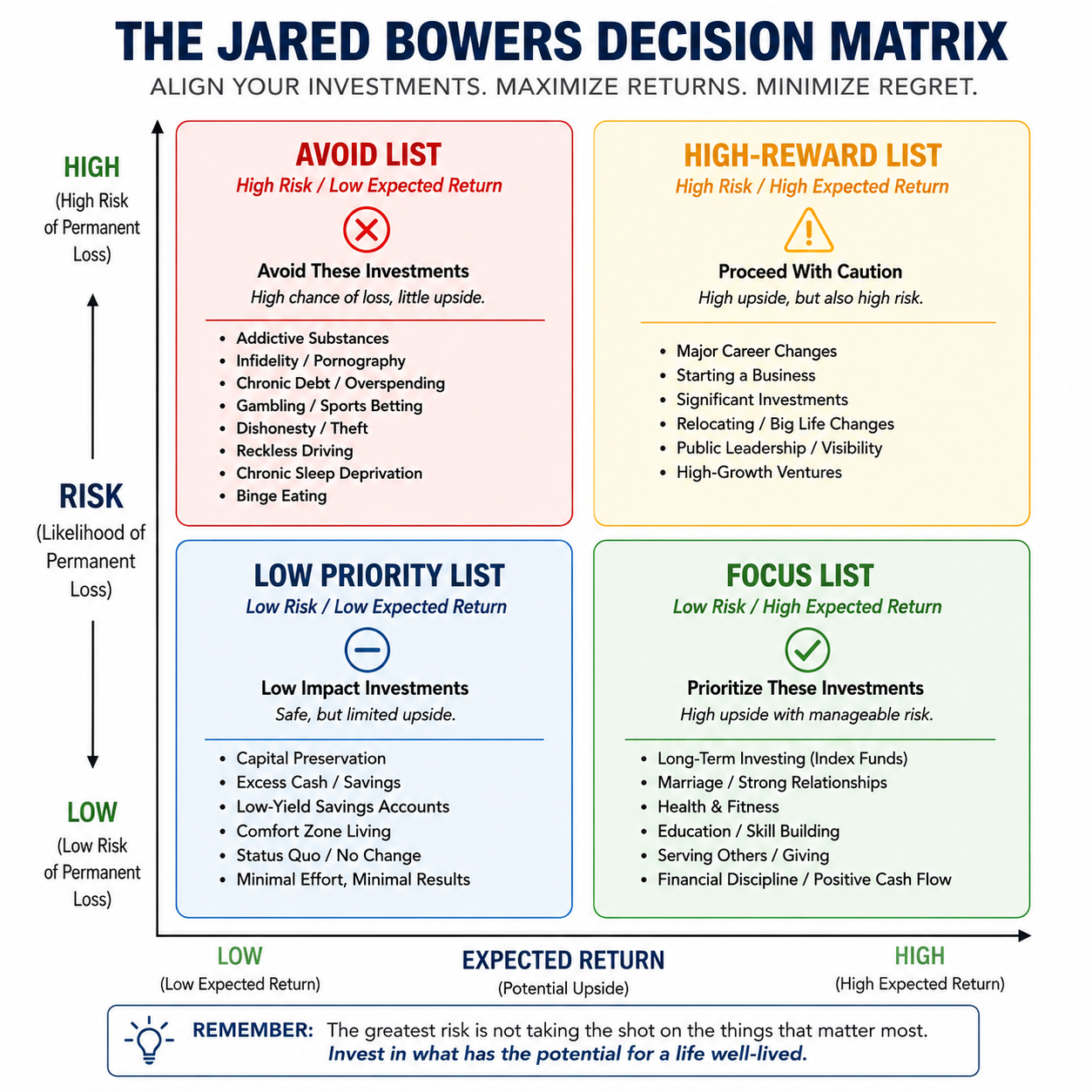
**I think ChatGPT did a pretty good job of capturing the essence of my decision matrix, don’t you?!
VIII. The Flat Line of Perceived Safety
- (42:04) Side-Stepping the Magic Quadrant: Most individuals completely sidestep the high-return, low-risk Magic Quadrant because they mistake its short-term price or lifestyle volatility for real danger. They anchor themselves in the comfort zone of Quadrant 1, hiding from discomfort while their long-term trajectory slowly shrinks.
- (42:51) Fragility vs. Frivolity: Don't ask what feels volatile; ask what is fragile. Zero volatility on a heart rate monitor is a flat line—and you do not want a flat line on the monitor of your life portfolio.
- (43:54) The Modern Risk Reframe: We reside in the safest era of human history; taking a risk no longer carries existential survival downside. Modern risk is merely a temporary code for personal discomfort, awkwardness, rejection, or short-term embarrassment. The single highest risk you face is limiting your own trajectory out of fear of a temporary bounce.
Next Episode: What Risk IS — Shifting from the common myths to identifying, measuring, and exploiting true structural risk in your life portfolio.