In Episode 041, Jared finishes this section on compounding by asking a different kind of wealth question: What does an enormous amount of wealth in life actually look like?
The answer has little to do with money. Jared argues that the most valuable accounts in life—relationships, health, reputation, expertise, spiritual life, love, trust, and time—can reach balances so valuable that even a billionaire could not buy them.
He illustrates this through the funeral of a woman whose accumulated “wealth” was visible in the hundreds of people she had cared for, connected, served, and influenced. Her investments did not stop producing returns when she died; the people she influenced continued making similar investments in others. That, Jared argues, is life compounding. Pasted markdown
From there, he introduces the Billion Dollar Equivalent Account: an account so valuable that you would not sell its existing balance for a billion dollars and a billion dollars could not recreate it. Long-term love, decades of trust, physical capability, deep expertise, reputation, community, and healthy years of life can all qualify.
A Warren Buffett thought experiment makes the idea concrete. Jared’s high-school students would gladly take Buffett’s $100+ billion fortune, but none would trade places with a 96-year-old Buffett to receive it. That reveals something important: they already value the decades ahead of them at well over $100 billion.
Jared then reframes the exponential compounding curve. Early investing feels brutally difficult because effort is high while visible progress is low. But as accumulated returns begin doing some of the work, the hill gradually flattens. What looks like “overnight success” is often decades of invisible compounding finally becoming visible.
The episode closes with a challenge: identify the accounts in your life that are already worth billions—or that you want to make worth billions—and then allocate your time, energy, and money as though you actually believe that valuation.
Detailed Sequential Outline
I. What Does Enormous Wealth Really Look Like?
- (0:33) Beyond the Financial Picture of Wealth: Jared asks listeners to picture enormous wealth. The instinctive answers are mansions, yachts, supercars, travel, and massive brokerage accounts.
- (1:27) The Most Valuable Accounts Aren’t Money: Money is useful, but Jared argues that life’s largest and most valuable balances often have nothing to do with it.
- (1:57) Money Cannot Simply Buy Them: Relationships, love, physical capability, reputation, expertise, and spiritual health can be built through compounding, but their accumulated balances cannot simply be purchased later.
II. A Funeral That Showed Life Compounding
- (2:35) Funerals Put Life in Perspective: Returning to Episode 040’s funeral theme, Jared argues that a good funeral can reveal what actually mattered in a person’s life.
- (3:44) A Friend Who Died Too Young: Jared recalls a woman who died in her 50s. Unlike Ronald Read, there was no shocking financial fortune discovered after her death—but the enormous balances she had built in life were obvious.
- (4:55) Time and Energy Built the Balance: She cared for people, connected people, served through church, school, hospitality, family, and community, and invested deeply in her children.
- (5:35) The Evidence of Compounding: The real return was not merely that she served people. Those people learned from her and served others. The people she connected formed more relationships. Her children carried values forward. Her community kept expanding through the people she influenced.
- (7:05) Returns That Outlive the Investor: Like well-invested financial capital, life returns can continue producing returns after the original investor is gone.
III. Introducing the Billion Dollar Equivalent Account
- (8:08) Life Can Produce Billion-Dollar Balances: Jared argues that multi-million- and even multi-billion-dollar-equivalent account balances are achievable in health, love, relationships, spiritual life, reputation, and other life accounts.
- (9:28) A New Concept: He names these Billion Dollar Equivalent Accounts—balances so valuable that their worth is meaningfully comparable to billions of dollars.
- (10:57) Available to More People Than Financial Billions: Few people will ever accumulate a billion dollars of money, but Jared argues that enormous balances in other areas are available to nearly everyone. Pasted markdown
IV. What Billion-Dollar Life Accounts Look Like
- (11:51) Relationships: A decades-old relationship that has adapted through growth, change, conflict, loss, reconciliation, and different seasons can become extraordinarily valuable.
- (12:45) Physical Health: A huge health balance means maintaining the capability to do meaningful things, travel, remain independent, and deploy energy into what matters throughout life.
- (13:07) Reputation: Decades of demonstrated credibility and trust allow someone to withstand setbacks, attract talented people, inspire others, and begin new ventures.
- (13:19) Expertise: Deep knowledge eventually becomes more than accumulated information. Experience permits synthesis, judgment, pattern recognition, teaching, and the creation of new ideas.
V. “Overnight Success” Is Usually Old Compounding
- (13:46) The Fund Manager Who Suddenly Raises Billions: Jared describes investment managers who leave established firms and apparently raise enormous new funds overnight.
- (14:27) Nothing About It Was Overnight: The money may arrive quickly, but it rests on 20, 30, or 40 years of compounding reputation, trust, relationships, and expertise.
- (14:53) Community Works the Same Way: When someone experiences a crisis and hundreds of people suddenly appear to help, the support may look spontaneous—but it represents relationship capital accumulated over decades.
- (15:13) A Few Decades to Become an Overnight Success: Compounding often remains invisible until the accumulated balance suddenly produces a highly visible return.
VI. Money Cannot Buy the Most Valuable Balances
- (16:10) More Useful Than “Priceless”: Jared jokes that calling something priceless is less helpful than assigning it an enormous hypothetical price. Thinking of these accounts as having nine or more zeros emphasizes their real magnitude.
- (18:00) Genuine Love Cannot Be Purchased: No amount of money can instantly buy a deeply loving relationship.
- (18:18) Healthy Time Cannot Be Bought Retroactively: Money can improve healthcare, nutrition, training, counseling, education, and access—but it cannot simply recreate decades of physical investment that never occurred.
- (19:05) Neither Can Trust, Expertise, or Spiritual Peace: Money can fund useful deposits, but it cannot purchase 40 years of marital trust, 25 years of expertise, lifelong credibility, or decades of friendship.
- (19:52) Money Is an Accelerator: Money can support the investment process. It is not a substitute for the time and energy required to build the balance.
VII. Warren Buffett and the Account You Already Value Above $100 Billion
- (20:58) Jared’s Classroom Thought Experiment: He asks his high-school investment students whether they would like Warren Buffett’s $100+ billion fortune. Unsurprisingly, they say yes.
- (21:47) The Trade They Refuse: Would they take the money if they also had to become a 96-year-old Warren Buffett? In roughly a decade of teaching, Jared has never had a student accept.
- (22:36) The Hidden Valuation: By refusing, those teenagers reveal that they value the decades between age 18 and 96 at more than Buffett’s fortune.
- (23:16) Time Is Already a Billion-Dollar Account: Most listeners would likely make the same choice. Yet we routinely spend pieces of that extraordinarily valuable balance on things that produce little return. Pasted markdown
VIII. Why Compounding Feels So Hard at the Beginning
- (24:04) Success Is Usually a Solved Problem: In many pursuits, the basic recipe is already known. The difficult ingredients are sustained effort, consistency, and time.
- (24:43) We Quit Before Compounding Arrives: Health, relationships, finances, and skill-building often feel unrewarding early because the deposits are doing almost all the work.
- (25:01) The Traditional Exponential Curve: Compounding charts look nearly flat for a long time before suddenly turning upward.
IX. Flip the Curve: The Effective Investment-to-Progress Curve
- (26:18) A Different Mental Picture: Jared proposes mentally flipping the traditional compounding curve to emphasize how much effort is required for each unit of progress.
- (27:14) The Hill Is Steepest at the Start: Early investment requires enormous effort for very little visible progress.
- (27:46) Then the Account Starts Helping: As the balance grows, accumulated returns begin putting in their own reps. Less new effort is required to produce the same amount of progress.
- (28:27) The Boulder Gets Easier to Push: Effective investing is not pushing a boulder up an increasingly steep hill. It is pushing it up a hill that gradually flattens.
- (29:24) The $250,000 Retirement Example Revisited: The couple who feared they were behind after 20 years had actually completed the hardest part. Their existing balance could now produce increasing amounts of future growth.
X. We Often Treat Billion-Dollar Accounts as Cheap
- (30:44) Time: We claim that our time is priceless, then trade hours, days, and years for things we barely remember.
- (31:29) Health: We may someday pay enormous amounts to regain lost capability while refusing to make relatively small investments in our bodies today.
- (31:47) Relationships: “Priceless” relationships too often receive leftover time and energy.
- (32:12) Expertise: We admire decades of accumulated skill while avoiding the boring repetitions needed to build it ourselves.
- (32:44) Allocation Reveals the Real Valuation: Our claimed value of an account and our actual allocation of resources toward it need to agree.
XI. Diversification Still Requires Concentration
- (33:01) Do Not Spread Yourself Infinitely Thin: Diversification matters, but meaningful balances require meaningful deposits.
- (33:49) Some Concentration Is Necessary: If time, energy, and money are spread across too many pursuits, nothing receives enough investment to compound substantially.
- (34:01) Meaningful Returns Require Meaningful Investment: A life that compounds needs concentrated investment in a handful of areas that truly matter.
XII. We Value What We Invest In
- (34:17) Building the Account Creates Part of Its Value: These balances matter not merely because of what they contain, but because of what it took to build them.
- (35:05) The Direction of Causality Matters: Jared returns to a recurring Vested principle: we do not merely invest in what we value; we value what we invest in.
- (36:03) Marriage, Expertise, and Fitness: Shared history and sacrifice create relational value. Trial and error create expertise. Discipline and accumulated adaptation create fitness. The investment itself changes the investor’s valuation of the account.
XIII. The Two-Part Test for a Billion Dollar Equivalent Account
- (37:12) Identify Your Accounts: Jared lands on a simple framework:
- You would not exchange the existing balance for a billion dollars.
- A billion dollars could not recreate that balance for you.
- (37:46) Accounts Worth Building: Romantic love, key relationships, physical and spiritual health, expertise, reputation, and other deeply accumulated balances can meet those criteria.
- (38:25) Start Now: If you want an account to become enormously valuable but are not investing in it today, the current allocation contradicts the claimed priority.
XIV. Live Like These Accounts Are Actually Worth Billions
- (39:19) Remember the Concept, Not the Math: Jared does not want listeners memorizing compounding formulas. He wants them to remember that their most important accounts may genuinely be worth billions.
- (39:50) Reverse the Perspective: If you were 96 with $100 billion, what would you pay to become middle-aged again? If you had a trillion dollars but a family consumed by conflict, what would you pay for peace and restored relationships?
- (40:36) Two Final Questions: Do you allocate resources to your most important accounts as though they are worth billions—or do your actions suggest that they are cheap?
- (41:07) Go Build Big Balances: Invest in health, relationships, love, reputation, skills, expertise, and the people around you. Everyone has access to becoming a billionaire in accounts that matter.
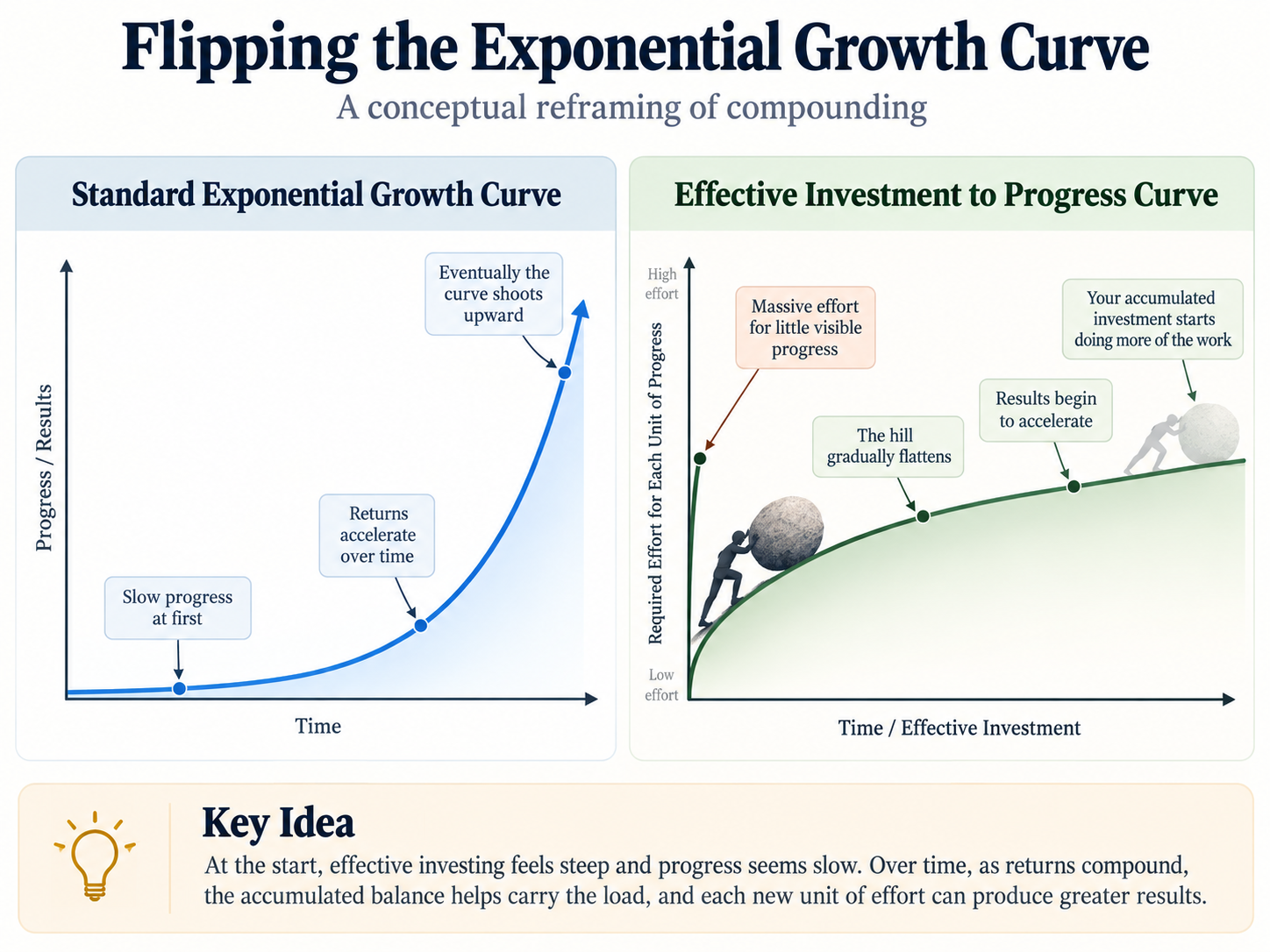
Image Credit: ChatGPT...based on my amazing description of the "Effective Investment to Progress Curve"