
Wealthy vs Poor Mindset (Part 2)
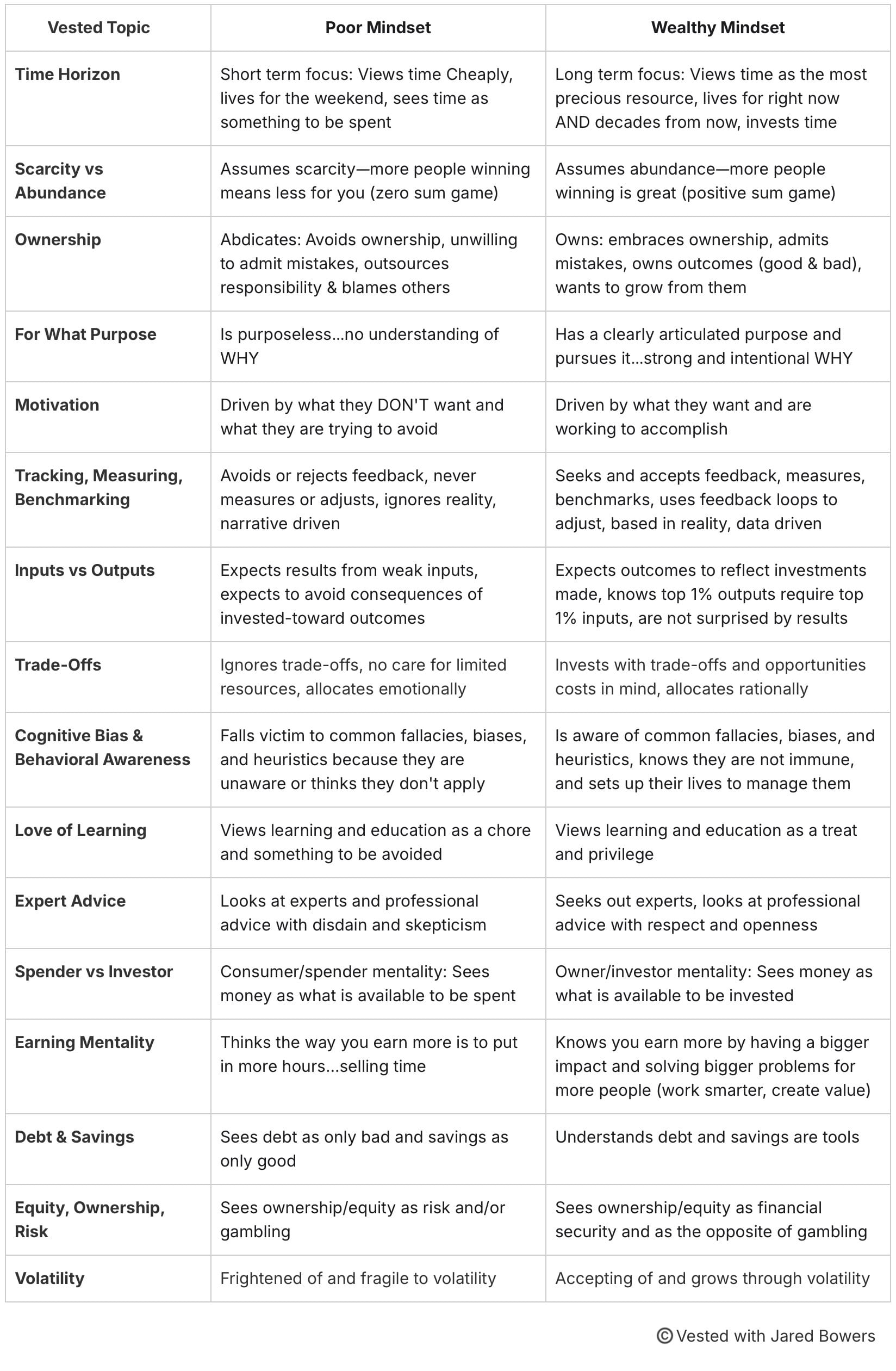
Full Wealth vs Poor Mindset Ledger
Synopsis
In Part 2 of the Mindset series, Jared moves from the bedrock of ownership into the mechanics of direction and data. This episode tackles the next seven parallels of the Wealthy vs. Poor Mindset, focusing on how a clearly articulated purpose serves as your "steering wheel" while objective measurement acts as your "dashboard." From the "terrifying irony" of avoidance-based motivation to the farming-rooted logic of inputs and outputs, Jared explains why your results are rarely a surprise once you audit your behavior. Learn why true millionaires are those who hold wealth rather than spend it, why "vibes-based" investing is a recipe for disaster, and why the willingness to be a humble beginner is the ultimate competitive advantage.
Sequential Outline
I. Introduction: The Goal of Mindset Training
- (0:38) Helpful vs. Harmful Defaults: A reminder that mindset is not about being a "good" or "bad" person, but about identifying default settings that either accelerate or sabotage your life portfolio.
- (1:21) Recap of Part 1: Briefly revisiting Abundance, Time Horizon, and Ownership.
II. Parallel #4: Purpose (Purposeless vs. Articulated "Why")
- (2:00) The Steering Wheel: Purpose is the largest determinant of your trajectory. Without it, you are merely "meandering."
- (3:00) The Financial Mandate: Professional portfolios require an investment mandate (time horizon, risk tolerance, objectives). Life portfolios are no different; without a purpose, every decision becomes emotional and reactive.
- (4:30) Avoiding vs. Shooting For: * Poor Mindset: Driven by avoidance (e.g., "I don't want to be fat," "I don't want a job I hate").
- Wealthy Mindset: Driven by specific aims (e.g., "I want to be strong to play with grandkids," "I want to build expertise to create value").
- (6:30) Consistency & Coherence: "I just want to be happy" is a desire, not a plan. Purpose turns desire into a manageable direction.
III. Parallel #5: Motivation (Avoidance vs. Pursuit)
- (8:54) The Magnet Effect: Avoidance is a magnet set to repel; pursuit is a magnet set to attract. Avoidance is directionless—you just go "away" from a point and end up wherever you bounce.
- (10:47) The Irony of Avoidance: Investing heavily in "not wanting" an outcome often creates the exact conditions for that outcome to occur (e.g., Anakin Skywalker, Voldemort, the defensive treaties of WWI).
- (13:46) Financial Avoidance: Trying to avoid all losses guarantees the ultimate loss—the erosion of purchasing power via inflation.
- (15:43) Staying Invested: Wealthy mindsets stay invested through volatility because they are pulled by a long-term goal rather than pushed by short-term fear.
IV. Parallel #6: Feedback & Adjustment (Vibes-based vs. Data-driven)
- (17:03) Tracking is Reality: Poor mindsets avoid data to protect the ego (the "Ostrich Approach"). Wealthy mindsets seek the truth, even if it's uncomfortable.
- (18:32) Fundamental Benchmarking: Jared tracks professional metrics—profitability, revenue growth, margin expansion—to steer portfolios. Life portfolios require the same tracking of time and energy "cash flows."
- (20:44) Measurement as Navigation: Measurement isn't for judgment or shame; it's how you decide where to steer. It corrects "drift" in spending, habits, and priorities.
V. Parallel #7: Inputs vs. Outputs ("Why Are You Surprised?")
- (23:00) The Farmer’s Logic: Jared shares his farming roots—you cannot expect a corn harvest if you plant kernels of corn but want beans. There is a direct, logical cause-and-effect relationship in the world.
- (25:13) The Misunderstanding of "Unfairness": Poor mindsets treat bad outcomes as random accidents. Wealthy mindsets view them as the "maturity" of previous investments.
- (26:44) Common Mismatches: Wanting financial stability without consistent saving, or wanting health while eating a "crap diet."
- (28:40) The Proper Response: When bad results show up, don't ask "Why me?" Ask "Why wouldn't it be me? I earned this trajectory."
VI. Parallel #8: Trade-offs (Ignoring Costs vs. Counting Costs)
- (30:30) Opportunity Cost: Every investment has a price. Hours on Netflix cannot be spent on a marriage. Money spent on status symbols cannot be invested in freedom.
- (32:30) Net Worth vs. Income: Net worth is the better indicator of health because it reveals the trade-offs actually being made.
- (33:36) The Millionaire Myth: Most people don't want to be a millionaire; they want to spend a million dollars. Once you spend it, you are no longer a millionaire—you are just someone who had money.
- (35:19) Sacrifice is Not Optional: Trade-offs are part of the game. Wealthy mindsets make them intentionally to get the outcomes they value more.
VII. Parallel #9: Cognitive Biases & Behavioral Awareness
- (37:55) The Illusion of Immunity: Poor mindsets think they are the exception to human psychology. Wealthy mindsets know they are just as susceptible to loss aversion, herd mentality, and confirmation bias as anyone else.
- (39:35) Systems Over Willpower: Because awareness doesn't provide protection, wealthy-minded investors set up systems (coaches, feedback loops, outsourcing) to manage their biases.
VIII. Parallel #10: Learning (Shortcuts vs. Iterative Iteration)
- (41:40) The Beginner’s Discomfort: Poor mindsets view learning as a chore and a shortcut to be found. They avoid learning because they cannot tolerate the humility of being bad at something.
- (43:16) Kung Fu and Reps: Since we cannot "download" skills, we are stuck with practice, feedback, and iteration. Skip the "shortcuts" and wax the car.
- (45:10) Highest Return Investment: Wealthy mindsets see learning as a privilege and an investment that compounds. To stop learning is to start declining—there is no neutral.
Quotes to Remember
"Purpose is the steering wheel. Without it, you’re just meandering."
"Avoidance is directionless. You cannot invest toward 'not something.' You can’t build a portfolio around a void."
"Efforts to invest in an avoidance direction often produce the exact existential risk you feared in the first place."
"Why are you surprised? You harvest what you plant. You cannot expect a harvest from seeds you never put in the ground."
"A millionaire is a person who has saved and invested their way to holding onto a million dollars. Someone who spends a million dollars is just someone who used to have money."
"Wealthy mindsets don’t measure to shame themselves; they measure to make adjustments. Measurement is how you decide what direction to steer."
"If you stop investing, you don't stay where you're at—you decline. There is no neutral."
Next Episode: Wealthy vs. Poor Mindset (Part 3): Completing the ledger with Expert Advice, Risk, and the "Expert Continuum."
Full Transcript
Introduction & Recap
(0:16) Good day, investors. (0:28) Welcome to the second episode of our Dive Into Mindset. (0:34) We are continuing our discussion from the last episode, talking about poor versus wealthy (0:40) mindset. (0:41) And we set the stage and talked about the first three last time. (0:46) And those had to do with abundance, time horizon, and ownership. (0:52) Three key mindsets for effective investing and getting positive returns in anything. (0:58) And today, we are going to dive right into several more parallels of wealthy versus poor. (1:05) And if you're hearing this without having listened to the previous episode, I think (1:09) you'll be just fine. (1:10) But I would recommend listening to that first episode first, because I think you'll get (1:15) a lot out of it. (1:16) But one of my goals is to make sure that every episode is able to stand on its own. (1:22) Still, most of the time, listening to things in sequence and in order will probably be (1:27) best.
Helpful vs. Harmful Default Mindsets
(1:28) And we only have one caveat before we dive into the parallels of wealthy versus poor. (1:34) And it's a reminder from last time. (1:36) What we are talking about isn't good people versus bad people. (1:40) This should be understood and heard as helpful default mindsets versus harmful default mindsets. (1:48) And all of us can operate in both of those, on the spectrum between wealthy and poor. (1:54) But we can learn to operate more on the wealthy side, more consistently. (1:59) That is the goal. (2:01) And after that lengthy preamble in the last episode, we are going to get right into it (2:05) now. (2:06) I owe you that.
Parallel #4: Purpose (The Clarifying Question)
(2:08) Okay, number four on the list, contrasting poor mindset with wealthy mindset, has (2:15) to do with purpose. (2:17) Specifically, a question that I ask often. (2:20) For what purpose? (2:22) A question that I believe we should be asking more frequently in what we're doing in life. (2:28) And as we look at the poor side of the ledger, the poor mindset is without purpose. (2:33) It is purposeless. (2:36) Someone in that mindset has no understanding of why. (2:39) Often they are being driven by avoidance, what they don't want. (2:44) And on the wealthy side, those with a wealthy mindset apply the question of for what purpose (2:50) to what they're doing and what they're trying to accomplish. (2:53) They have a clearly articulated purpose, and they pursue it. (2:58) They have a strong and intentional why.
(3:01) Purpose is something that I talk about a lot. (3:04) Because more than anything else, it sets the path that you are on. (3:08) It points your trajectory overall. (3:11) Because it determines what you invest in. (3:15) And it encompasses a lot of the main themes. (3:18) Time horizon. (3:19) Ownership. (3:19) Motivation. (3:21) Inputs versus outputs. (3:23) All of those things important to financial investing, yes, but just as much or even more (3:29) so to life investing. (3:31) Purpose is direction. (3:33) It's the steering wheel. (3:35) Without it, yeah, you're still moving. (3:37) You're still going somewhere, but you're not actually pointed toward an intended destination. (3:43) You're just going places. (3:46) What's that called, meandering? (3:48) There is a better way.
Defining Success and Investment Mandates
(3:50) And let me liken this to the financial side of things. (3:54) At my company, we spend a lot of time with each client figuring out the purpose that (3:59) they intend for their money and for their financial path. (4:03) And you may or may not be surprised to hear that an overarching goal of get rich, stay (4:08) rich, be rich usually isn't enough. (4:12) The purpose that we're shooting for is what governs almost everything else. (4:17) When someone doesn't know their purpose, every decision becomes emotional, reactive, (4:22) short term, and inconsistent. (4:25) It's hard to allocate resources intentionally and then allow those resources to grow over (4:30) time. (4:30) It's a problem if you don't know the intended destination or direction. (4:35) And I, as a portfolio manager, will not be able to answer the essential question, what (4:40) is the definition of success for that money in that portfolio? (4:44) That would be like trying to manage a portfolio of investments without an investment mandate.
(4:49) Without knowing the time horizon, the return objective, the risk tolerance, the constraints. (4:55) And that is not a place where we want to be. (4:58) So, for each of our clients, we work together to create a financial plan and an investing (5:04) plan which outlines all of this and more. (5:07) If you don't know what winning is, you can't build a plan to win. (5:12) And bringing this back to purpose, if you don't know your purpose, it's very difficult (5:17) to build a portfolio that will result in progress towards it. (5:22) When it comes to other areas of life beyond money, you can't manage those very well if (5:26) you don't know what you're building. (5:28) If you don't know what you're shooting for and striving for, what you're actually growing, (5:33) where you are going, without knowing what matters to you and why you are investing (5:39) in the first place.
Driving with a Steering Wheel vs. Drifting
(5:41) And the question for what purpose is meant to clarify. (5:45) It should help you get the answers to the important questions. (5:49) And a person without purpose is trying to drive without a steering wheel, regardless of what (5:55) aspect of life we're talking about. (5:57) And as we know, life is a portfolio of investments, and how we allocate our time, our energy and (6:03) our money determines the direction that we go and the returns that we get. (6:08) If we don't have an investment strategy, we are going to have a random collection of stuff. (6:15) A bunch of accounts, maybe some investments that we are just hoping are going to magically (6:19) work out. (6:21) That is, to be fair, how many people operate in many areas of life. (6:26) But a wealthy mindset builds with intention, rather than just reacting or drifting.
(6:32) Let's consider fitness. (6:34) A poor mindset approach is something like, I don't want to feel like garbage, or I don't (6:40) want to be fat. (6:42) And those are things that many of us might want, but pay attention to the language. (6:47) It isn't about what they want, it's about what they don't want. (6:52) Those goals are very broad and unspecific. (6:57) What is not wanted versus approaching fitness from a standpoint of clearly articulating (7:02) what you do want, and what you are trying to accomplish. (7:06) For instance, something like, I want to be strong and healthy for the purpose of fill (7:12) in the blank. (7:13) I want to be able to coach my kids and then play with my grandkids for years and decades (7:17) to come. (7:19) I want to be able to travel the world with the love of my life well into our golden (7:23) years.
Purpose in Career and Marriage
(7:24) Let's look at it from a career standpoint. (7:27) The poor mindset approach would be something like, I don't want a job that I hate. (7:32) And if you think about that framing, that is more about a job you don't want versus something (7:38) that you are shooting for. (7:40) Or the poor mindset of, I just want to make more money. (7:45) That is at least a positive frame, but it's unspecific and it's purposeless. (7:49) Because making more money is pretty empty without a reason why. (7:54) Those types of goals, if you can call them that, result in everything being reactive. (8:01) Jumping between roles based on discomfort or based on short term liking and disliking. (8:07) Versus a wealthy mindset that says, I want to build expertise in this so that I can create (8:13) value or build something that I really care about.
(8:18) Now they're going to make purposeful choices in the projects that they take on, in the (8:23) skills that they invest in, the professional relationships that they cultivate, and the (8:27) risks that they take. (8:30) Purpose creates consistency and coherence. (8:33) That is why, I just want to be happy, isn't a plan, it's a desire. (8:39) Purpose turns desire into direction. (8:43) Let's talk about marriage. (8:45) The poor mindset as it relates to purpose in marriage is something like, I just don't want (8:50) to fight. (8:51) Or I just want to get through the day without everything being a big deal. (8:56) So, that approach results in avoiding conflict, which usually results in problems continuing (9:03) unaddressed, which results in resentment, then distance, which often results in, eventually, (9:11) contempt. (9:12) And it is very hard to come back from contempt in a relationship when that has set in.
(9:19) Versus the wealthy mindset in marriage as it relates to for what purpose. (9:24) Let's say a purpose that says, I want to build a deep, resilient, intimate partnership that (9:30) is going to last the rest of our lives. (9:33) And not just last, be excellent. (9:37) So then, with that frame and with that goal, conflict becomes productive, or at least it (9:42) can be. (9:44) It becomes about setting the direction, getting on the same page. (9:48) You're mutually aligned on trying to solve issues. (9:52) That question of, for what purpose, is critical. (10:00) We see this from kids oftentimes, don't we? (10:00) I didn't try to make a mess, well, did you try not to? (10:04) I didn't try to hurt him, well, did you try not to?
Clarifying Direction: "Did You Try Not To?"
(10:10) And those childish tendencies can follow us and often do follow us into adulthood. (10:15) I didn't try to end the month broke, well, did you try not to? (10:20) I didn't try to add 20 pounds over the past few years since I turned 30. (10:25) You can see where this is going, did you try not to? (10:29) And even better, because it should be about what we are investing toward and not just (10:33) what we are trying to avoid, for each of these examples, did you try to be intentionally neat? (10:39) Did you intentionally try to manage your spending well? (10:43) Did you try to eat healthy and move appropriately? (10:47) And that is why the question, for what purpose, is so clarifying and can be a dividing line (10:55) between poor and wealthy when it comes to our mindset and our approach to life.
Parallel #5: Motivation (Avoidance vs. Pursuit)
(11:01) And all that ties directly into the next item on our poor versus wealthy list. (11:07) Number five, let's talk about motivation. (11:11) And you are going to hear a lot of similarities with our last parallel on purpose. (11:16) Because this approaches a similar theme from a different angle. (11:20) That is probably an indication of how important I believe these themes of purpose and motivation (11:25) are. (11:26) The poor side of the ledger when it comes to motivation are people being driven by what (11:32) they don't want and what they are trying to avoid. (11:36) Versus the wealthy mindset side is that we are driven by a goal. (11:40) We are driven by what we want to accomplish, what we are working to achieve. (11:45) It is the magnet that is turned to repel on the poor side versus to attract and go after (11:51) on the wealthy side.
(11:53) And you can see how this fits very naturally and pairs well with what we just talked about (11:57) with purpose. (11:59) Maybe it could be consolidated with number four that we just talked through, but I think (12:03) it deserves its own parallel and its own deep dive. (12:05) Because our motivation and what is driving us determines our direction. (12:10) And it does tie directly into our purpose. (12:14) It underlies that very important question of for what purpose. (12:18) And it adds another one, another clarifying question. (12:22) What is motivating me in the first place? (12:25) Those two questions are very much related. (12:28) And the reason that we ask the second question, what is motivating me in the first place, (12:33) is because it is really hard to make consistent progress for a long time without proper motivation.
Aspiration-Based Pursuit vs. Fear-Based Avoidance
(12:41) And that motivation and direction is the fifth parallel between wealthy and poor. (12:46) The motivation of avoidance versus the motivation of pursuit is key because motivation pulls (12:52) our energy. (12:53) It allows us to push through discomfort. (12:56) If we are motivated in the right direction, it is powerful. (13:00) Motivation doesn't replace discipline, but it determines whether you are going to keep (13:05) putting in the reps for long enough for a compounding to show up. (13:09) Our motivation is the difference between being fear-based, what we are trying to avoid on (13:14) the poor side, and being aspiration-based, what we are trying to accomplish on the wealthy (13:19) side. (13:20) Because life built around avoidance is a shrinking life. (13:24) It's a life that's getting smaller. (13:26) But a life built around pursuit is an expanding and growing life.
(13:32) And it is reflected in the returns that we get. (13:35) The poor side of the motivation ledger can feel productive in the moment. (13:40) I don't want to be broke. (13:41) I don't want to be overweight. (13:43) I don't want to fight in my marriage. (13:45) I don't want to get fired. (13:46) I don't want to disappoint people. (13:50) But avoidance is directionless. (13:54) It's putting that magnet that repels near the thing that you don't want. (13:59) And that results in you going in whatever direction you happen to be going in when you (14:03) bounce off of it. (14:05) It's placing a target in a negative space where all the rest of the space around it (14:10) is what's open and who knows what direction you're going to end up if all you are shooting (14:15) for is not, is away from an outcome.
Compounding the Void
(14:20) Congratulations! (14:20) You avoided landing on that specific point. (14:23) But where did you actually end up? (14:26) And you cannot invest toward not something. (14:30) You can't build a portfolio around a void. (14:34) If our motivation comes from a negative direction, lacking a positive motivation, we have reactive (14:41) decision making. (14:42) Our allocation of effort and time and money will be inconsistent based on emotion and (14:49) short-term thinking. (14:50) Which is a lack of compounding or compounding in the direction that we do not want. (14:56) Because keep in mind, poor investments can have poor returns that compound as well. (15:02) And ironically, as many movie and book plots have shown us, and some of our own real-life (15:07) examples have likely taught us, working hard in the avoidance direction, investing toward (15:13) outcomes that we don't want, often creates the exact outcomes that people fear.
The Irony of Avoidance: Star Wars & History
(15:20) And that they are working so hard to avoid. (15:22) Star Wars comes to mind. (15:25) Anakin has visions of his love, Padme, dying. (15:28) So he takes avoidance action. (15:31) He really leans into it. (15:33) Seeks out forbidden powers, the dark side, to prevent her death. (15:37) Results in her death. (15:40) And that classic line, the very thing you swore to destroy. (15:46) Hmm. (15:48) Harry Potter is another one that comes to mind for me. (15:51) A child is prophesied to beat the all-powerful Dark Lord Wizard. (15:55) So therefore, the Dark Lord Wizard takes a whole lot of avoidance action. (16:00) And the outcome is that he creates the exact conditions that allow him to be defeated.
(16:06) But it's not just in fictional books and movies. (16:09) This happens in real life. (16:12) Let's talk about this on the big scale in real life. (16:16) It's happened throughout history and it's led to massive consequences. (16:20) Periods of great fear and uncertainty. (16:23) Consider World War I. (16:25) Countries had a fear of being isolated. (16:28) They were vulnerable. (16:29) So they created a dense web of mutual defense treaties that resulted in a single assassination (16:35) triggering a global war. (16:37) I know that that is probably a bit of an oversimplification. (16:41) It applies here. (16:43) Defensive systems that are revved up to the maximum oftentimes create offensive results. (16:49) The same overall situation, but thankfully without the World War, at least so far, (16:54) started in the Cold War arms race.
Cold War Arms Race and Investing Risks
(16:57) Two world superpowers, fearful that they were going to be weaker than their enemy. (17:03) So the avoidance action was to create massive stockpiles of nuclear arms. (17:08) And the outcome was heightened global instability. (17:12) Massive fear. (17:14) For decades. (17:15) There were multiple instances, many that we likely don't even know about, (17:20) where complete apocalyptic collapse could have occurred. (17:24) Almost occurred. (17:25) And there is an irony in that. (17:28) A terrifying irony. (17:30) Efforts to invest in a negative direction, in an avoidance direction, away from something (17:35) that we don't want, often produces the existential risk that we feared in the first place.
(17:42) Consider being an investor when it comes to money. (17:45) When all we do as an investor is try so hard to avoid losses at all costs, what we do is (17:52) lock in zero returns by owning nothing with any volatility, which is actually in the long (17:57) run, much, much worse than the volatility, the ups and downs in a general rightward and (18:03) upward positive direction. (18:05) All that effort to avoid losses may be what guarantees the loss. (18:12) Because our money is guaranteed to lose purchasing power over time. (18:16) That is the guarantee in life when it comes to investing. (18:20) We will talk more about that in the future, don't worry.
Parallel #6: Feedback & Measurement (Narrative vs. Data)
(18:24) But contrast that with a wealthy mindset. (18:26) Pursuit as an investment strategy. (18:29) Being driven by what we are trying to accomplish. (18:33) Asking, what do I want to build? (18:35) What do I want to become? (18:37) What is the long-term outcome that I'm aiming for? (18:41) What's worth investing in today that will compound tomorrow and next week and next month (18:46) for years to come that I can invest in consistently? (18:51) Someone who is driven by what they are trying to avoid says, I don't want to lose money (18:55) because I don't want to feel bad or feel scared. (18:59) Versus someone who is being driven by what they are trying to accomplish says, I want (19:05) to build durable wealth that I can do great things with by owning great businesses through (19:09) the ups and the downs.
(19:11) On the poor side, the behavior results in panic selling when things are going down or (19:16) never investing at all. (19:18) And on the wealthy side, the investing behavior is that they invest and they stay invested. (19:23) And that is one of the harder things to do, especially when it comes to volatile times (19:28) in the markets. (19:30) But they weather through it, through the volatility. (19:33) And better yet, they take advantage of it when it happens. (19:37) They invest more, they reallocate. (19:40) But the most important thing is, they invest and they stay invested. (19:45) On the poor side, the investment portfolio is overweight cash, stagnant assets, going (19:50) nowhere. (19:52) And on the wealthy side, the portfolio is built for long-term growth.
(20:03) Calling back to one of our previous parallels in the last episode on poor versus wealthy. (20:08) And the outcomes from those two opposing approaches in life are not difficult to forecast. (20:14) This fifth parallel of poor versus wealthy, our motivation of avoidance versus our motivation (20:20) of pursuit, can and does apply to so many areas of life. (20:29) But let's move on to the next one on the list. (20:31) Number six. (20:31) And this has to do with feedback and adjustment. (20:35) Tracking, measuring, and benchmarking. (20:38) Very important tools when it comes to investing. (20:41) The poor mindset avoids or rejects feedback. (20:46) They don't measure and they rarely make adjustments. (20:50) They would rather ignore reality. (20:52) They're driven by fantasy narrative rather than objective data. (20:56) They're vibes-based, if you will.
Objective Measures for Time and Energy
(20:59) And on the wealthy side of the ledger, they embrace feedback. (21:03) When it comes to tracking, measuring, and benchmarking, those with a wealthy mindset (21:07) look for ways to objectively evaluate themselves and their investments. (21:11) They seek feedback and accept feedback when it's given, even if it's hard. (21:16) They measure progress or regress if that is happening. (21:20) They benchmark their returns and they use feedback loops in order to make adjustments. (21:26) This is true for money and it's even more true for time and energy because those things (21:31) are harder to see drifting and so need to be tracked and measured more closely. (21:37) Approaching this with a wealthy mindset means that you're based in reality and you're data-driven.
(21:42) And this is why this is a big deal. (21:45) This parallel between poor and wealthy is where most people (21:48) clearly reveal whether they live in reality or some narrative that's made up. (21:53) Because tracking is reality. (21:56) Real data. (21:57) Objective. (21:58) People with a poor mindset rarely do some form of tracking, measuring, or benchmarking. (22:03) And they judge progress based on feelings rather than evidence. (22:07) They assume that they're doing good enough, or not doing too bad, (22:11) without actually having the data. (22:13) The real numbers to back it up or to prove it. (22:16) Because they don't really want to know the real numbers.
Company Fundamentals and Benchmarking
(22:20) People with a wealthy mindset want the truth, even if it's uncomfortable. (22:24) Because they know that they cannot improve what they do not measure. (22:28) And we measure and benchmark the investments that we care about. (22:32) And this is another very easy parallel to make with money. (22:37) Specifically the world of investing. (22:40) I care a lot and spend a lot of time on benchmarking and tracking my clients' returns. (22:45) My returns. (22:46) If I do not have an accurate picture of where things are at (22:50) and where I've come from, not just from a return standpoint, (22:54) but also when it comes to the metrics inside the portfolio and the businesses (22:58) that I care about even more, I won't be able to steer the portfolio well.
(23:03) Because those are the things that are going to eventually result in positive returns. (23:08) Those things are how profitable are my companies? (23:11) Have they grown quarter over quarter or year over year? (23:14) From a fundamental standpoint. (23:17) Revenue, cash flow, earnings. (23:19) Are their margins expanding, contracting, or stable? (23:23) What's the health of their balance sheet? (23:25) Not just now, but compared to where it was last year and in years past. (23:30) Do the operators of the company own more of the company now than they did before? (23:35) How much of it do they own? (23:36) Which tells me, are they aligned with me? (23:39) Is the company growing their market share or are they shrinking?
(23:43) Are they staying the same? (23:45) Fine in a rapidly growing market, not so fine in a slow growth market. (23:50) None of those things can I answer and therefore can I have a good and accurate view of the (23:55) health of my overall portfolio without accurate tracking, measuring, and benchmarking. (24:00) And that goes far beyond simple price returns. (24:04) The price returns are the easy part. (24:06) And, of course, the price returns are what we're shooting for. (24:09) But if we are going to be successful, we need to care about the actual numbers. (24:14) The fundamentals. (24:16) And you need to have an accurate way of identifying and measuring those.
The Ostrich Approach vs. Navigational Correction
(24:20) And there are plenty of investors out there that are vibes-based on the poor side of the (24:26) mindset ledger. (24:27) And that applies to money investing and in all the other areas of investing as well. (24:32) But people on the poor side of the ledger often equate or confuse the lack of data with (24:38) a lack of problems. (24:39) That is a strategy of avoidance. (24:42) And it's often there to protect the ego. (24:45) Because we can pretend like things are going in the right direction if we don't actually (24:49) pay attention to the results. (24:51) But that is the ostrich approach. (24:54) Sticking our head in the ground. (24:56) That approach doesn't stop reality. (24:58) It just blinds us to it.
(25:00) With a wealthy mindset, measurement isn't just judgment. (25:04) It is how you navigate forward. (25:07) People with a wealthy mindset don't measure to shame themselves or other people or make (25:11) themselves feel better in contrast. (25:14) People with a wealthy mindset measure to make adjustments. (25:17) To make sure that they're pointed in the right direction. (25:20) Measurement is how you decide what direction to steer. (25:24) It's how you correct. (25:25) It's how you optimize. (25:27) Identify misallocation. (25:29) Recognize progress and double down on that progress. (25:33) Measurement builds confidence and speeds up compounding.
Benchmarking the Life Portfolio
(25:37) Tracking and measuring is answering the question, where am I at right now? (25:41) Benchmarking is answering the question, compared to what? (25:44) And then the adjustments that we need to make is putting those things into practice. (25:49) What do I need to change to get on the right course? (25:52) Or to stay on the right course? (25:55) I literally run my investment portfolios this way. (25:58) And I do my best to run my life portfolios the same way. (26:01) Because that is how portfolios are built and perform well over decades. (26:06) I've used the analogy of a pilot before. (26:09) But imagine taking the poor mindset approach of vibes and feelings with something like that. (26:15) Ah, we'll just eyeball it.
(26:17) And we'll probably get there. (26:18) I think we're heading in the right direction. (26:21) I think we can identify that as insanity. (26:24) Even a slight drift off course from a pilot results in not ending up in the wrong city, (26:29) but maybe in the wrong state. (26:30) Maybe the wrong country, depending on how long the flight is. (26:33) And that brings up an important point. (26:36) Because time amplifies results. (26:39) And it amplifies the direction that we're going in. (26:42) Our habits and our investments have a tendency to drift. (26:46) Our spending has a tendency to drift. (26:49) Our priorities and attention drift over time. (26:52) But if we track, measure, and benchmark those things, (26:55) we can stay focused in the right direction.
Parallel #7: Inputs, Outputs, and "Why Are You Surprised?"
(26:57) The wealthy mindset seeks out objective measures, even when it's hard. (27:02) And this leads us to number seven on our mindset list. (27:06) The poor versus wealthy ledger. (27:09) And to the very important question that we are going to ask many times from here. (27:14) Which is, why are you surprised? (27:18) The poor mindset expects results from weak or no inputs. (27:22) The poor mindset expects to avoid consequences of invested toward outcomes. (27:27) Many times, those outcomes had negative inputs attached to them. (27:31) Or they were the result of a lack of investing in a positive direction.
(27:36) Contrast this with the wealthy side of the ledger. (27:39) Someone with a wealthy mindset expects outcomes to reflect the investments made. (27:44) They know that top 1% outputs require top 1% inputs. (27:49) They know that bottom-tier inputs are probably going to result in bottom-tier returns. (27:54) And more importantly, people with a wealthy mindset are not surprised (27:59) by the results of the investments that they have or have not made. (28:04) This parallel of examining and being objective and honest about inputs and outputs (28:10) exposes a fundamental misunderstanding. (28:13) Or, said in a different way, it aligns a fundamental truth.
(28:17) We do not get the returns that we do not invest toward. (28:21) Or, said not as a double negative, we get the returns that we invest toward. (28:27) The poor mindset treats outcomes like random events or accidents (28:31) and the results of an unfair world. (28:34) But the wealthy mindset knows that outcomes are the result of returns generated from investments. (28:40) We get the account balance that we invest toward. (28:43) Why are you surprised? (28:46) Don't be.
Logic of the Harvest: Farming and Life
(28:47) There are a lot of good examples that I could talk through (28:50) to illustrate this poor versus wealthy mindset regarding our inputs and outputs. (28:56) But I want to talk about farming. (28:58) I grew up on a farm. (29:00) I come from a family of farmers. (29:02) There were many generations of farmers that came before me. (29:06) I loved farming growing up. (29:08) I should say I loved a lot of things about farming. (29:11) I decided that I loved investing more, which is why I'm doing what I'm doing now. (29:16) But I am very thankful for my farming roots and I'm very thankful for my experience on the farm.
(29:21) It taught me what hard work actually is. (29:24) I learned a whole lot of life skills that I still carry with me in my toolkit every day. (29:30) And it taught me that there are very direct cause and effect relationships in the world. (29:36) That is foundational to farming and foundational to many, many, many areas of life. (29:41) You harvest what you plant in the ground and that you take care of. (29:45) You cannot expect a corn harvest in the fall if you don't plant kernels of corn in the spring. (29:52) You cannot expect to get a bean harvest in the fall if you only plant kernels of corn in the spring.
(29:57) You cannot get exotic plants to grow from conventional crop seeds (30:02) or in climates that don't support them. (30:05) I don't think I'm saying anything groundbreaking. (30:08) Wink wink. (30:09) And because of this very direct cause and effect relationship, (30:13) farmers are often some of the most logical cause and effect driven people that you will encounter. (30:18) They understand cause and effect intuitively because that is the world that they operate in. (30:23) If they don't make the inputs, you cannot get any outputs. (30:28) You cannot manifest your way to a great harvest. (30:31) You cannot hope your way to the cows getting milked.
Expecting Withdrawals from Unfunded Accounts
(30:35) The outputs that you get are the very direct result of the inputs you made along the way. (30:42) But so many times in life, we expect to get a harvest from seeds that we never planted. (30:47) We expect to be able to make withdrawals from accounts that were never funded. (30:53) We expect returns from investments that were not made. (30:56) Or we expect to get certain kinds of returns out of an account that we deposited a very (31:02) different kind of input into. (31:05) The poor mindset logic is, I want a great marriage, but I didn't invest any time. (31:11) I don't invest any time.
(31:13) The poor mindset logic is, I want financial stability, but I don't save or invest consistently. (31:20) The poor mindset says, I want to be healthy, but I don't exercise. (31:25) I sleep poorly and I eat a crap diet. (31:27) The poor mindset logic is, I want deep caring friendships, but I don't want to reach out to (31:33) people or show up. (31:34) I want a big meaningful career, but I don't want to invest in building skills. (31:39) I want wealth, but I avoid ownership. (31:43) And in that mindset, with that mindset, outcomes seem unfair, mysterious and unpredictable or (31:50) disconnected.
(31:52) But looking at it with the investor lens, or the farmer lens, the wealthy lens, what (31:58) was grown was not any of those things that were desired, but it was what was planted. (32:03) It was what was invested. (32:05) There is no surprise. (32:08) And when predictable results show up that were the result of what we planted, what we (32:13) invested, but what we didn't want, oftentimes the poor mindset results in, why me? (32:19) Or, woe is me. (32:21) But the only proper response is, why wouldn't it be me? (32:26) I earned this. (32:27) I invested toward this outcome.
Parallel #8: Tradeoffs & Opportunity Costs
(32:29) And I've said this before, but this is good news. (32:33) Because we can and should expect to get the positive results and returns of the purposeful (32:39) and productive investments that we have made. (32:41) Let's not be surprised. (32:44) Man, I could keep talking about this for a long time, but I'm going to move on. (32:50) Let's talk about another fun one. (32:52) Tradeoffs. (32:53) This flows well from what we were just talking about. (32:56) That is on purpose. (32:58) The order of this list is intentional. (33:01) By the way, the full list of poor versus wealthy traits is on the website.
(33:07) Ha, I waited to tell you that until we were halfway through the list. (33:11) I could have saved you so much time. (33:13) But instead, I made you listen to me. (33:16) You can look for the link to the website in the episode description. (33:21) Our website is vestedjb.com. (33:24) But on to number eight, tradeoffs. (33:27) And by tradeoffs, I mean that every choice, every investment that we make comes at some (33:32) sort of cost. (33:34) And the poor mindset likes to ignore tradeoffs or pretend that they don't exist. (33:40) The poor mindset likes to imagine that resources are unlimited or that costs can be avoided.
(33:46) They want outcomes without paying the price. (33:49) Contrast that with the wealthy side of the ledger. (33:53) Tradeoffs are understood and respected. (33:55) A person with a wealthy mindset allocates investments with tradeoffs and opportunity (34:00) costs firmly in mind. (34:02) And they know that resources are limited. (34:05) And they make deliberate tradeoffs that are aligned with their purpose. (34:09) See, people with a poor mindset, especially in this category, want things as if wanting (34:15) were enough. (34:17) People with a wealthy mindset understand that wanting doesn't matter a whole lot.
The Cost of Allocation and Diversification
(34:22) Investing is what moves the needle. (34:24) And everything comes at a price. (34:27) As it relates to investing money, if we use that money for one investment, we do not have (34:33) that money to be used for another. (34:35) I may have nearly unlimited options to choose from, but I cannot own everything. (34:40) If I want to own the 40 or so companies that I believe build the best portfolio, I cannot (34:45) own the other 20,000 companies out there on the public markets. (34:50) And if I want to own everything and be completely diversified, I give up my chance to do better (34:55) than the market because the market is everything.
(34:58) Which isn't bad, but you are giving something up. (35:02) So if you own all of it, you are going to perform exactly in line with it. (35:07) Money is easy to talk about when it comes to tradeoffs and the poor versus wealthy mindset. (35:12) People who manage their money well understand that if they want to spend a big chunk of (35:16) their money, they will not have that money to invest. (35:19) It is a tradeoff. (35:21) People that treat their money with rationality know that if they spend it, they don't have (35:26) it to put in their portfolio to own something with it for a long period of time and then (35:30) realize the compounding that can come from that.
Net Worth as the Indicator of Tradeoffs
(35:33) The wealthy-minded investor knows that holding cash to lower volatility will maybe make you (35:38) feel nice and safe, but it comes at the cost of future returns. (35:44) And once a resource has been invested, it cannot be used elsewhere, at least not until (35:49) it's unlocked and reallocated. (35:51) And this is why net worth is a better indicator of financial health than income alone, because (35:57) net worth reveals tradeoffs that are actually being made. (36:01) More accurately, it reveals the tradeoffs that have been made. (36:05) And life is the same. (36:07) Hours spent on Netflix cannot be spent on building a marriage.
(36:11) Energy poured into social media cannot be poured into building skills. (36:15) Money spent on status cannot be invested in future financial freedom. (36:21) Those things I mentioned are not bad, but they are a cost. (36:26) They are a tradeoff. (36:27) The stomach that you fill with junk food cannot be filled with and get the benefits of healthy, (36:33) nutritious food. (36:34) Life is about tradeoffs. (36:36) Everything comes at a cost. (36:39) And those with a poor mindset like to treat choices as if they are costless. (36:44) And, hearken back to what we were talking about earlier, (36:48) they are surprised by the results when those costs come due.
Spenders vs. Millionaires
(36:53) People with a wealthy mindset count the cost before choosing their investments. (36:58) Because once they allocate a resource, it cannot be easily allocated elsewhere. (37:03) Those with a poor mindset want to have money, but they also want to spend it. (37:07) And many people say that they want to be a millionaire. (37:10) But, and you may have heard this phrase before, (37:13) what they actually want is to have a million dollars to spend. (37:17) And at that point, they are no longer a millionaire. (37:19) They are just someone who spent a million dollars.
(37:22) A millionaire is the person who has saved and invested their way (37:25) to holding onto a million dollars that they then are going to keep invested (37:30) and not spend, at least not yet. (37:34) Those with a poor mindset want well-behaved kids without (37:38) teaching, training, disciplining, and consistently parenting them. (37:42) They want to feel great the next day and have plenty of energy, (37:45) but they also want to stay up late. (37:48) They want the skills and results without putting in the reps. (37:53) This poor mindset when it comes to trade-offs and opportunity costs (37:56) is the wrong side of the ledger.
Parallel #9: Cognitive Biases & Awareness
(38:01) Why is this so hard? (38:03) Why can't I have both? (38:05) Why does everything require sacrifice? (38:08) Because it is a sacrifice. (38:11) Trade-offs are not optional. (38:13) They are part of it. (38:14) So let's make the intentional trade-offs to get the outcomes that we want, (38:19) that we would rather have, (38:22) rather than the accidental trade-offs that result in the outcomes (38:25) that you didn't want in the first place. (38:27) On the wealthy side, they aren't just choosing this. (38:31) They are choosing this instead of that.
(38:35) They are doing it with eyes wide open, intentionally. (38:38) And when done well and with a wealthy mindset, (38:41) we can see the trade-offs, (38:42) not just in a negative frame of costs, (38:46) but we can see them and treat them for what they actually are, (38:49) investments. (38:51) And if we manage our trade-offs appropriately, (38:54) we can and should be happy with the investments that we are making. (39:00) Okay, onto the next parallel. (39:03) Number nine on our list of wealthy versus poor mindset (39:07) have to do with cognitive biases and behavioral awareness.
(39:11) On the poor side of the ledger, (39:13) people are blind to biases or they intentionally ignore them. (39:18) They are unaware of their own behavioral patterns. (39:20) They believe that they are the exception (39:22) and they do not fall victim to behavioral biases (39:26) or practice certain heuristics in their decision-making. (39:29) On the wealthy side, (39:31) they know that they are susceptible to these common issues, (39:35) biases, fallacies, behavioral heuristics. (39:38) They are just as susceptible as anyone else. (39:42) They know that they are not immune to them, (39:44) but they do what they can to manage and avoid them.
Managing Behavioral Heuristics
(39:48) And what I'm referring to about these behavioral biases (39:51) are things like loss aversion, hindsight bias, (39:54) overconfidence, confirmation bias, herd mentality, (39:58) the availability heuristic, the endowment effect. (40:02) Now, some of you when I list these things (40:05) are going to be familiar with many or even all of them, (40:07) but some will not be and that's fine. (40:09) That's okay. (40:10) I'm not going to spend a lot of time (40:12) digging into and unpacking each of these (40:14) because there would be a lot to unpack. (40:17) Here's some quick examples.
(40:20) Overconfidence, believing that we are right based on our knowledge (40:24) or the assumption that we are objective. (40:27) Regret aversion, where people avoid making decisions (40:30) or taking actions based on the fear that they might regret it. (40:35) Endowment bias is thinking that the things that we own (40:37) are more special and more valuable than they are. (40:41) The herd mentality, chasing after trends, (40:44) buying into the market when it's going up, (40:46) selling out of the market when it's going down. (40:49) Hindsight bias, thinking that what we know now (40:52) was always known.
Outsourcing Management to Avoid Bias
(40:54) We'll have time to get into all these (40:56) in the future in more detail, (40:57) but the important thing, I believe, (40:59) and this is based on evidence in my own life (41:02) and in the lives of the people that I work with (41:04) and the people that I help, (41:05) these biases are present in all of us (41:08) and we are all at risk of falling into these. (41:11) And a funny thing about biases and cognitive errors (41:15) is that just being aware of them (41:17) does not give us protection from them. (41:20) The poor side of the ledger assumes (41:22) that they're not at risk at all. (41:23) They think that these don't apply (41:25) or if they know about them, (41:27) that they can easily avoid them (41:28) just by knowing about them.
(41:30) And their lives reflect that. (41:33) But that doesn't work. (41:34) That actually makes it more likely (41:37) that they fall victim to them. (41:39) Those operating on the wealthy side, (41:41) they are aware of the common fallacies though, (41:44) the biases. (41:45) They know that they are not immune to them (41:46) and they set up their lives (41:48) to try to avoid or manage them. (41:50) And I believe that none of us really are immune. (41:53) We all fall victim to many of these biases and errors. (41:58) Again, those operating on the wealthy side (42:00) know that they are not immune to these.
(42:03) And that is the important thing. (42:05) And the next important thing (42:07) is that they set up their lives (42:08) to avoid or manage them as best as they can. (42:11) They outsource things that need to be. (42:13) They hire coaches. (42:14) They pay experts. (42:15) They listen to experts. (42:17) They seek feedback from people close to them (42:20) in their lives that can point out (42:21) where they're falling victim to these things. (42:24) This is something that we may talk about (42:26) more in the future, (42:26) but I want to say that (42:28) practicing and getting better at seeking feedback (42:30) can be a superpower.
Parallel #10: Approach to Learning
(42:33) Of course, we also need to apply that feedback. (42:36) And those with a wealthy mindset (42:38) actively ask themselves the question, (42:41) where are these biases present in my life (42:43) and in my thinking? (42:44) I think that we could have a lot of fun (42:46) talking about these common cognitive biases (42:48) in the future (42:49) because it tells us so much about human nature (42:51) and investing psychology. (42:54) But we are going to settle (42:56) for just this overview for right now. (42:59) The poor mindset thinks that those rules (43:01) apply to other people. (43:03) The wealthy mindset knows (43:04) that these rules apply to me first.
(43:08) Let's talk about our final (43:10) wealthy versus poor mindset parallel for today. (43:14) And this has to do with (43:15) how we approach learning. (43:17) The poor mindset views learning as a chore (43:20) and something to be avoided if possible. (43:23) They're looking for shortcuts or hacks (43:25) to avoid having to make an effort. (43:28) If learning is required, (43:30) it's something to be gotten over with (43:32) or gotten through. (43:33) On the wealthy side, (43:35) learning is embraced for what it is, (43:37) an opportunity and a privilege. (43:40) In many cases, (43:42) it is a treat that can and should be savored. (43:45) It's seen as a worthwhile investment (43:47) toward a worthwhile aim.
The Beginner's Discomfort
(43:49) Let's dig into the poor side a bit more. (43:52) Learning and education on the poor side of the ledger (43:54) is a chore. (43:56) Again, something to be avoided most of the time, (43:58) if it can be. (44:00) Those who approach learning (44:01) on the poor side of the ledger (44:02) don't avoid learning (44:04) because they don't want the skills or the knowledge. (44:07) From what I see, (44:08) and I've felt this way myself plenty of times, (44:11) they want to avoid ever feeling like a beginner. (44:14) Because feeling like a beginner is uncomfortable. (44:17) It doesn't feel good to be bad at something.
(44:21) The core behind this (44:22) is the investment of time, (44:24) attention, (44:25) and the application of humility. (44:27) People with a poor mindset (44:29) can't tolerate the discomfort (44:31) of being a beginner, (44:32) of being incompetent, (44:33) of moving from incompetence to competence, (44:37) admitting that they don't know something. (44:39) That is an uncomfortable position to be in. (44:42) And the older we get, (44:44) generally, (44:45) the less willing we are (44:46) to subject ourselves to that discomfort. (44:49) The phrase, (44:50) you can't teach an old dog new tricks, (44:52) is grounded in this reality.
Avoiding the Iterate Process
(44:54) We often remove ourselves from the pool (44:57) of being a beginner in something, (44:59) and we just stick with what we already know. (45:01) But there are a lot of people (45:03) when it comes to the view of education (45:05) and their approach to learning (45:06) that exhibit a poor mindset. (45:09) We probably see it all around us. (45:11) And those same people (45:12) want results, (45:14) but without putting in the reps. (45:16) They see being bad at something (45:18) or not knowing something (45:20) as a reason to avoid it altogether. (45:22) And many of those people (45:24) see education as an obligation, (45:26) something that they have to do (45:27) or that they're forced to do.
(45:29) And yet, (45:30) they still encounter a lot of content, (45:32) they still encounter a lot of useful information, (45:35) but then they don't apply it. (45:37) They avoid that key part (45:39) of the education process (45:40) and the process of learning, (45:42) which is practice, (45:43) feedback, (45:44) correction, (45:44) and then iteration. (45:45) Doing it again. (45:47) Oftentimes because we didn't do it right (45:49) the first time (45:50) or the first many times. (45:52) And this creates issues. (45:54) Most people want to skip straight to the tournament. (45:57) Nobody wants to wax the car (45:59) and paint the fence, (46:00) so to speak, (46:01) to get ready for it.
Iterative Process vs. Instant Download
(46:02) But since we can't download (46:04) Kung Fu directly into our brains, (46:07) yet, (46:07) we are stuck with (46:09) the iterative and slow (46:10) and sometimes uncomfortable process of learning. (46:13) So, (46:14) let's examine the other side. (46:17) Those operating with a wealthy mindset (46:19) see learning and education as a treat, (46:22) as a privilege, (46:23) as the investment that it is. (46:26) They embrace being a beginner (46:28) and understand (46:29) that skills build and compound (46:31) and need to start somewhere, (46:33) usually at the beginning. (46:36) Related to feedback, (46:37) someone with a wealthy mindset (46:39) will value feedback from others (46:40) as a way of learning about themselves (46:42) and their blind spots.
(46:44) And then they can actually grow from that. (46:46) People with a wealthy mindset (46:48) lean into learning (46:49) because they know that every skill (46:51) is deposit-driven (46:53) and every deposit compounds. (46:56) And learning is not something (46:58) that is just nice to have. (47:00) It is one of the highest return investments (47:01) that exists in life. (47:04) The wealthy-minded folks (47:05) don't just value progress. (47:07) They value the things that result (47:09) in the eventual progress. (47:12) And from that mindset, (47:14) when we are operating at our best, (47:16) we need to embrace being a beginner.
The Beginner-to-Expert Continuum
(47:18) We need to be willing to start as a beginner (47:21) because the wealthy-minded understand (47:24) that learning is a lifelong practice. (47:27) And even when you are a legitimate expert, (47:31) there are lessons to be learned (47:32) and people to learn from. (47:34) Those on the wealthy side of the ledger (47:37) consume a lot of information (47:38) and they also convert that information (47:41) into application and action. (47:43) They measure their progress. (47:45) They benchmark how well they're doing. (47:47) They measure themselves (47:48) based on what progress they're making (47:50) on that beginner-to-expert continuum.
(47:53) And that, what I just mentioned, (47:55) the beginner-to-expert continuum, (47:57) is something that we will dig into (47:58) more in the future. (48:00) But there is a path that we all take (48:02) as we are learning something. (48:04) And it has to start at beginner. (48:07) We eventually get to proficient, (48:09) which is necessary to then be able (48:12) to move forward into anything (48:14) that could be considered expertise. (48:16) It is a path that we move down. (48:19) And the wealthy mindset embraces learning. (48:23) And, as I said, you have to start somewhere. (48:26) Usually at the very beginning.
Conclusion and Next Steps
(48:29) A very good place to start. (48:31) And anyone who has built proficiency (48:34) or true expertise in something (48:37) knows that you can't do so (48:38) by avoiding the beginner stage. (48:41) Which, again, is uncomfortable, admittedly. (48:45) And the most successful people, (48:47) those that exhibit a wealthy mindset (48:49) in most areas, (48:50) are people who embrace learning (48:51) and do it consistently. (48:53) Because if you stop learning, (48:55) you don't just stay where you're at, (48:57) you decline. (48:58) As we've talked about, (48:59) there is no neutral. (49:01) Remember, deposits and withdrawals.
(49:04) And we are going to pause (49:06) the list right here. (49:08) That was number 10. (49:10) We're going to start next time (49:12) with number 11. (49:14) And make it through the rest of the list (49:16) and then talk about application. (49:18) And we'll start our next discussion (49:20) with a topic that I'm very fond of. (49:22) Expert advice. (49:24) I dole out a lot of it. (49:25) Jury's out on how expert it is (49:27) in many cases. (49:29) And until then, (49:30) consider where you may fall (49:32) on the wealthy versus poor ledger (49:33) with these parallels (49:34) that we talked through today. (49:37) Understanding that we can and do (49:38) and will move along (49:40) the wealthy versus poor spectrum. (49:43) Okay, thank you (49:45) for investing in yourself (49:47) and in those around you. (49:49) I will talk to you next time. (50:04) Which side of the ledger am I on? (50:07) Oh boy, depends on the day.
(50:11) [End of Transcript]